


 English
 русский
 Español


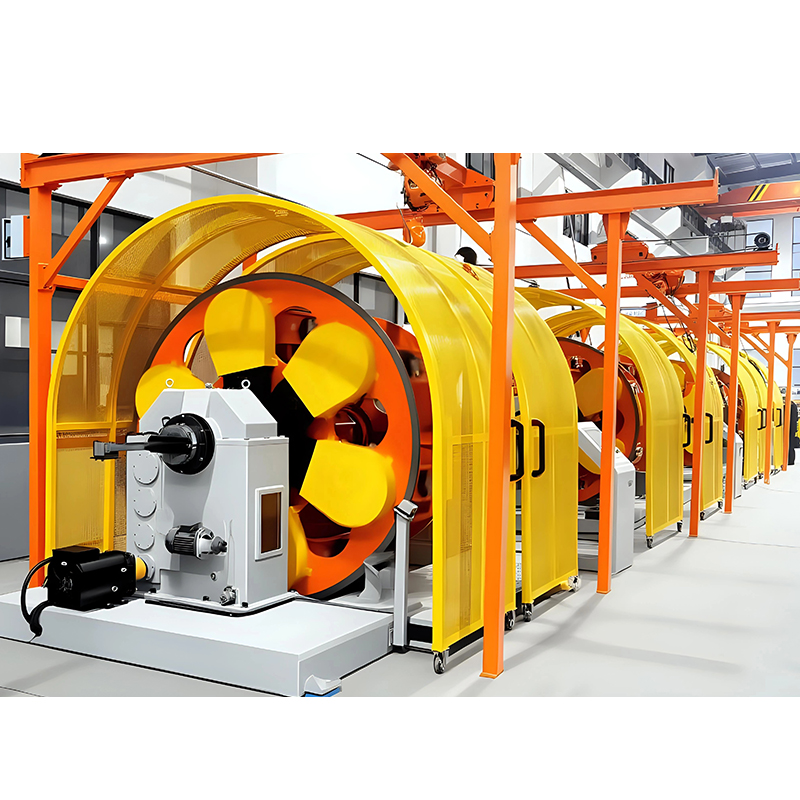
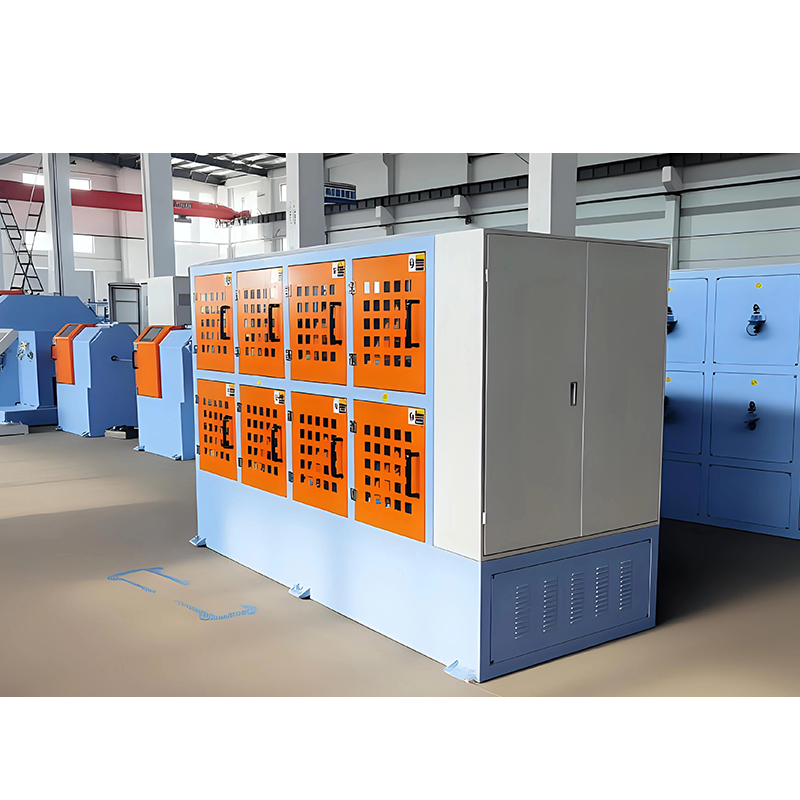
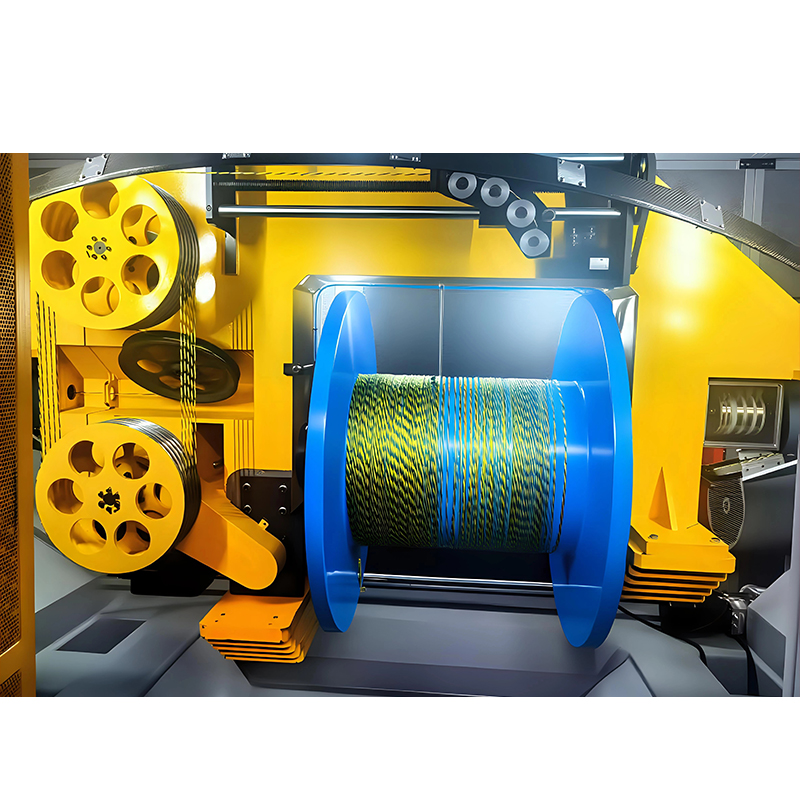


Global standards for conductor stranding include specifications for wire diameter, number...
Technical Specifications
The table below summarizes the standard performance and dimensional parameters of our tubular stranding system range. Custom configurations are available upon request for non-standard conductor diameters, bobbin counts, or lay length requirements.
| Parameter | Standard Range / Value |
| Number of Bobbins | 7 / 12 / 19 / 24 / 37 (configurable) |
| Bobbin Flange Diameter | 250 mm – 800 mm |
| Max. Wire Diameter (Single) | 0.05 mm – 12.0 mm |
| Stranding Tube Rotation Speed | Up to 1,800 rpm (model-dependent) |
| Line Speed | 5 – 200 m/min |
| Lay Length Range | 8 mm – 500 mm (stepless adjustment) |
| Stranding Direction | Left-hand (S) / Right-hand (Z) — switchable |
| Closing Die Diameter | Customized to conductor OD |
| Capstan Drive | AC servo motor with encoder feedback |
| Take-up Reel Diameter | 400 mm – 1,600 mm |
| Main Drive Power | 7.5 kW – 90 kW (model-dependent) |
| Tension Control | Dancer arm + magnetic powder brake (per bobbin) |
| Frame Material | Heavy-duty cast iron / welded steel |
| Control System | PLC + 10-inch touch-screen HMI |
| Supply Voltage | 380V / 415V / 480V, 3-phase (customizable) |
| Operating Temperature | 0 °C – 45 °C |
| Machine Dimensions (L × W × H) | 4.5 m – 18 m × 1.2 m – 2.8 m × 1.6 m – 2.4 m |
| Net Weight | 2,500 kg – 28,000 kg (model-dependent) |
| Certification | CE, ISO 9001:2015 |
| Conductor Materials Supported | Copper, Aluminum, Steel, CCA, ACSR, Alloy |
All specifications are subject to confirmation based on final product requirements. Our engineering team can provide detailed drawings, 3D models, and layout plans prior to order confirmation.
Application
Tubular stranding systems are deployed across a remarkably broad spectrum of cable manufacturing scenarios, making them one of the most versatile machine categories in the industry. Below is an overview of the primary fields and specific product types where these systems deliver exceptional results.
- Power Cable Conductors: The most common application, tubular stranders produce multi-wire conductors for low-, medium-, and high-voltage power cables. Stranded copper or aluminum conductors improve flexibility and current-carrying efficiency compared to solid conductors, making them ideal for grid-level distribution and building wiring.
- Overhead Transmission Lines: ACSR (Aluminum Conductor Steel Reinforced) and AAC (All-Aluminum Conductor) cables used in overhead power lines require precise concentric stranding with tight lay-length control — a task tubular stranders handle with ease at production speeds competitive enough to meet utility-scale demand.
- Telecommunications Cables: Twisted-pair and multipair telephone cables, data cables (Cat.5e / Cat.6 / Cat.6A), and coaxial cable cores all rely on tubular stranding or bunching to achieve the necessary electrical balance and crosstalk attenuation required by telecommunications standards.
- Armored and Instrumentation Cables: Steel wire armoring (SWA) and steel tape armoring (STA) applied over cable cores use tubular stranders to lay armor wires uniformly, providing mechanical protection for cables routed through conduits, buried underground, or installed offshore.
- Flexible and Control Cables: Fine-wire bunching applications for flexible cords, elevator cables, robotics trailing cables, and industrial control cables demand precise pitch control and consistent twist per unit length — requirements met by variable-speed tubular stranding configurations.
- Automotive and Aerospace Wiring: Lightweight twisted-pair and shielded cables for vehicle CAN bus systems, aircraft avionics harnesses, and EV battery wiring harnesses are produced using high-speed tubular bunching and stranding lines specifically tuned for thin-gauge, high-purity copper or silver-plated wire.
- Submarine and Offshore Cables: Subsea power and fiber-optic cable assemblies require multi-layer concentric stranding of both conductors and tensile strength members. Tubular stranders equipped with high-capacity take-up reels handle the substantial weight and stiffness of these large-diameter assemblies.
- Specialty Wire Products: Medical device cables, mining cables with flame-retardant jackets, railway signaling cables, and nuclear plant instrumentation cables all have unique stranding specifications that tubular systems can accommodate through customized die sets and tension profiles.
Thanks to the ease with which bobbin count, tube speed, and take-up parameters can be adjusted, a single tubular stranding line can often serve multiple application categories within the same production facility — maximizing capital equipment utilization and reducing the need for dedicated single-purpose machines.
Advantages
Choosing a tubular stranding system over alternative stranding technologies is a decision that pays dividends throughout the entire lifecycle of your cable manufacturing operation. Here are the key advantages that set these machines apart.
- High Production Speed: Because the bobbins remain stationary while only the outer tube rotates, centrifugal forces on the wire are dramatically reduced. This allows the machine to achieve rotation speeds of up to 1,800 rpm — far exceeding what is safely achievable with rigid frame or planetary stranders of comparable bobbin count. Higher rpm translates directly into greater line speed and more meters of finished cable per shift.
- Consistent Lay Length Accuracy: Servo-driven capstan and take-up units combined with closed-loop feedback control maintain the programmed lay length to within ±1% tolerance across the full production run. This level of consistency is critical for cables where electrical performance — such as characteristic impedance in data cables — is directly dependent on twist pitch.
- Low Wire Tension Variation: Individual dancer arms and magnetic powder brakes on each bobbin position ensure that every wire enters the stranding point under equal, controlled tension. Uniform tension prevents conductor deformation, reduces scrap rates, and produces a geometrically tight, round stranded core with excellent surface finish.
- Bidirectional Stranding: The ability to switch between left-hand (S) and right-hand (Z) lay directions without major mechanical reconfiguration is a practical advantage in multi-layer cable designs and when fulfilling contracts with opposing helical direction requirements.
- Wide Product Range from a Single Machine: Modular closing die holders, adjustable bobbin positions, and programmable speed ratios allow a single tubular strander to handle product diameters across a broad range without the need for a completely separate machine investment.
- Reduced Maintenance Downtime: Fixed-axis bobbins experience far less mechanical stress than bobbin cradles in rigid frame stranders. Sealed, self-lubricating bearings in the tube assembly extend service intervals significantly, and quick-change bobbin holders reduce reel changeover time to a fraction of what older machine designs require.
- Energy Efficiency: Optimized main drive designs, regenerative braking on the take-up axis, and variable frequency drives (VFDs) on all major motors reduce total energy consumption by up to 20% compared to older fixed-speed machine designs — a meaningful saving when machines run multiple shifts daily.
- Operator-Friendly Control: A color touchscreen HMI presents all critical process parameters on a single screen. Recipe storage allows operators to recall exact settings for repeat orders in seconds, eliminating the risk of human error during setup and reducing trial scrap at the start of each production run.
- Scalable and Future-Ready: Our machines are designed with expansion in mind. Ethernet connectivity, OPC-UA data interfaces, and compatibility with MES (Manufacturing Execution System) platforms allow tubular stranding lines to be integrated into smart factory environments, supporting real-time process monitoring, predictive maintenance, and traceability requirements.
Material and Structure
The performance of a tubular stranding system is inseparable from the quality of its core mechanical components and the engineering discipline applied to their selection and integration. Every major assembly in our machines is designed for longevity, precision, and ease of maintenance.
Machine Frame: The base frame is fabricated from heavy-gauge structural steel sections, fully welded and then stress-relieved before machining. This ensures dimensional stability over years of high-speed operation and prevents the vibration-induced resonance that can shorten bearing life and compromise stranding geometry. All critical machined surfaces are precision-ground on CNC machining centers to tolerances of ±0.01 mm.
Stranding Tube Assembly: The rotating tube — the defining structural element — is manufactured from high-tensile alloy steel and dynamically balanced to G2.5 grade or better in accordance with ISO 21940. Precise balancing at operating speed is essential to prevent vibration at high rpm, which would introduce unwanted tension fluctuations in the wires. The tube is supported at both ends by large-diameter, deep-groove ball bearings or tapered roller bearings, selected according to the radial and axial load profile of each machine size.
Bobbin Cradle and Holders: Each bobbin position features a hardened steel shaft, precision-bored cradle arms, and an easily releasable locking collar that secures the bobbin flange without the need for tools. The cradle geometry is machined to keep the wire tangent point aligned with the stranding axis, minimizing transverse wire bending as it exits the bobbin.
Wire Guide and Closing Die System: From each bobbin, the wire passes through polymer-lined guide tubes or ceramic eyelet guides before converging at a tungsten carbide or hardened steel closing die. Carbide dies offer superior wear resistance when stranding hard-drawn copper or steel wires, while polished hardened steel dies are suitable for soft-drawn copper and aluminum. Die holders are designed for rapid exchange — an important production-efficiency feature when the machine serves multiple product families.
Capstan and Take-up Unit: The capstan drum is driven by an AC servo motor through a precision helical gearbox, providing smooth, backlash-free torque delivery. The take-up unit uses a traverse mechanism with programmable pitch to ensure even, cross-wound coil formation on the shipping reel. The traverse pitch is automatically adjusted by the PLC as the reel diameter grows, maintaining a consistent winding angle throughout the fill cycle.
Tension Control Components: Each bobbin position is equipped with a spring-loaded dancer arm that provides passive tension buffering, supplemented by a magnetic powder brake whose braking torque is continuously regulated by the PLC based on the dancer arm position signal. This dual-mode approach handles both slow, quasi-static tension drift and fast transient tension spikes caused by any irregularity in the incoming wire.
Lubrication System: Main bearings in the tube assembly are connected to a centralized automatic grease lubrication circuit that delivers measured quantities of high-temperature grease at timed intervals, ensuring consistent lubrication film without the risk of over-greasing. Secondary bearings throughout the machine use sealed, pre-greased units that typically require no field lubrication for the life of the bearing.
Safety Guards and Enclosures: Interlocked polycarbonate and steel mesh guards enclose all rotating tube sections. Emergency stops are located at both the operator station and along the machine perimeter, and a light curtain across the infeed zone prevents inadvertent access during operation. All safety interlocks are dual-channel, meeting PLe / Cat. 4 requirements under ISO 13849.
