


 English
 русский
 Español


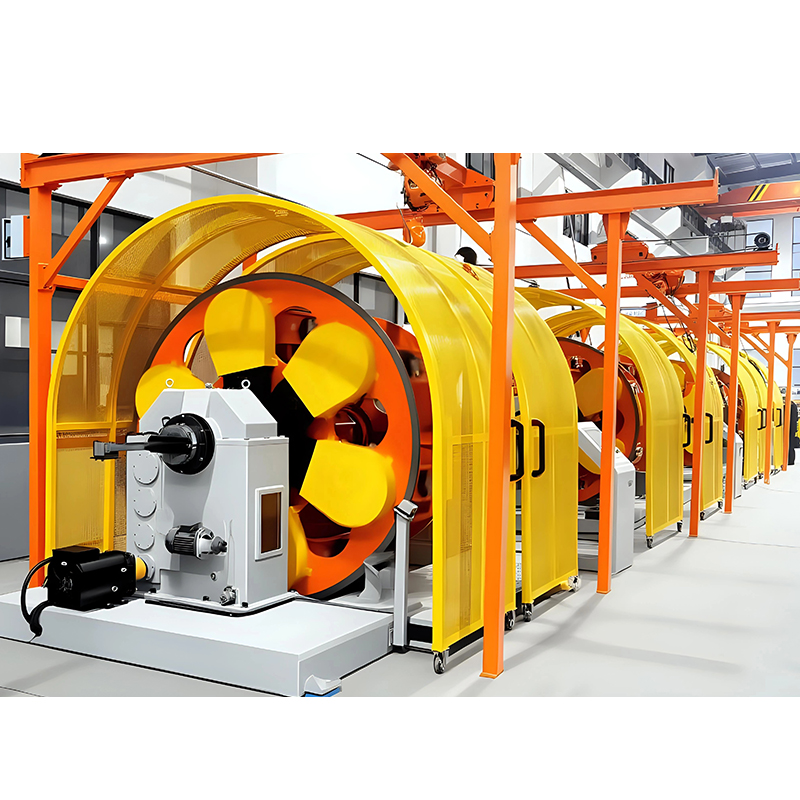


Global standards for conductor stranding include specifications for wire diameter, number...
Specifications
| Parameter | Details |
| Machine Type | Drum Stranding Machine (Single-layer / Multi-layer) |
| Applicable Materials | Copper, Aluminum, ACSR, Steel, Stainless Steel, Alloy Conductors |
| Number of Strands | 7 / 19 / 37 / 61 / 91 wires (customizable) |
| Single Wire Diameter | 0.3 mm – 6.0 mm |
| Finished Cable OD | 2 mm – 120 mm |
| Take-up Drum Capacity | PN 400 – PN 2500 (flange diameter up to 2500 mm) |
| Stranding Speed | Up to 120 rpm (drum rotation) |
| Lay Length Range | 20 mm – 5000 mm (servo-adjustable) |
| Lay Direction | Left-hand (S) / Right-hand (Z) selectable |
| Tension Control | Dancer arm + servo motor closed-loop system |
| Drive System | AC Frequency Inverter / Servo Drive |
| Control System | Siemens / Mitsubishi PLC + Touchscreen HMI |
| Main Motor Power | 15 kW – 315 kW (model dependent) |
| Voltage / Frequency | 380V / 415V / 440V, 50Hz / 60Hz (customizable) |
| Lubrication | Automatic centralized lubrication system |
| Safety Features | Wire break detection, overload protection, E-stop, safety guards |
| Certification | CE, ISO 9001 |
| Warranty | 12 months standard, extended warranty available |
Application
Drum stranding machines serve a broad spectrum of industries where multi-wire stranded conductors form the backbone of electrical infrastructure, communication networks, and structural reinforcement. Their flexibility and precision make them indispensable across the following key sectors:
- Power Transmission and Distribution Cables: Stranding bare aluminum (AAC), aluminum alloy (AAAC), aluminum conductor steel reinforced (ACSR), and all-aluminum alloy conductor (ACAR) for overhead lines at voltages ranging from 11 kV to 765 kV. Drum stranders ensure precise lay ratios critical to the electrical and mechanical performance of these conductors.
- Underground Power Cables: Manufacturing copper or aluminum conductors for XLPE-insulated, armored underground cables used in urban power distribution, industrial facilities, and renewable energy installations including solar farms and wind parks.
- Telecom and Data Cables: Stranding copper pairs and quad elements for telephone cables, and stranding steel wire armor (SWA) or aluminum wire armor (AWA) for submarine and direct-burial fiber-optic and coaxial cables.
- Automotive Wiring Harnesses: Producing fine-stranded flexible copper conductors for high-current cables in EVs, HEVs, and conventional vehicles — including battery connection cables, motor leads, and charging cables.
- Offshore and Submarine Cables: Stranding copper conductors and steel wire armors for dynamic submarine cables used in oil and gas platforms, offshore wind farms, and inter-island power links where robust mechanical performance is critical.
- Mining and Industrial Cables: Manufacturing heavy-duty flexible stranded cables for mining equipment, cranes, excavators, and industrial robots — applications where repeated flexing demands highly flexible stranded cores.
- Welding Cables: Producing ultra-flexible fine-wire copper strands for welding leads and electrode cables that must withstand constant movement and thermal cycling.
- Aerospace and Defense: Stranding tinned copper and silver-plated conductors for lightweight, high-reliability wiring systems in aircraft, satellites, and military equipment where strict tolerances are non-negotiable.
Advantage
Selecting a drum stranding machine provides wire and cable manufacturers with measurable advantages in productivity, quality, and total cost of ownership. Here is why industry leaders consistently choose drum stranders:
- High Production Speed: All pay-off bobbins rotate together inside the drum, eliminating the back-twisting forces common in tubular stranders. This enables stranding speeds up to 120 rpm, reducing cycle times and increasing throughput per shift.
- Consistent Lay Length Accuracy: Servo-controlled lay length adjustment ensures every meter of cable meets the specified pitch ratio. Tolerances within ±1% of nominal lay length are routinely achievable, critical for IEC and ASTM compliance.
- Large Drum Capacity: Take-up drums with flange diameters up to 2500 mm allow for very long production lengths per run, dramatically reducing splice points in the finished cable and improving field reliability.
- Superior Cable Flexibility: The helical stranding geometry distributes bending stress evenly across all wires in the bundle, resulting in cables with excellent fatigue resistance and longer service life compared to unilay or concentric-lay alternatives.
- Low Wire Breakage Rate: Dancer-arm and servo-feedback tension systems keep individual wire tension within a narrow window throughout the run, minimizing breakage — a major cause of production downtime and material waste.
- Fast Product Changeover: PLC-stored production recipes allow operators to switch strand count, lay direction, and lay length with a few touchscreen inputs rather than time-consuming mechanical adjustments, supporting high-mix production environments.
- Energy Efficiency: Variable frequency drives on main and auxiliary motors reduce energy consumption during acceleration, deceleration, and idle periods by up to 30% compared to older fixed-speed designs.
- Comprehensive Safety Systems: Integrated wire-break sensors, overload protection, access door interlocks, and emergency stop systems protect both operators and tooling, reducing workplace incidents and insurance costs.
- Global Standards Compliance: Cable products produced conform to IEC 60228, ASTM B8, BS 6360, and DIN VDE 0295, supporting export-oriented manufacturers worldwide.
Material and Structure
The durability and precision of a drum stranding machine depend on the quality of its materials and structural design. Here is a breakdown of the key mechanical and electrical components:
- Main Frame and Drum Shell: Fabricated from heavy-gauge structural steel (Q345 or equivalent), stress-relieved by heat treatment and precision-machined to ensure concentricity and minimal vibration at high rotational speeds. The drum shell is cast iron or welded steel plate with balanced counterweights to reduce dynamic loads.
- Pay-off Bobbin Cradles: Machined from ductile iron or steel and fitted with sealed, grease-lubricated roller bearings rated for continuous high-speed rotation. Each cradle is independently tensioned, allowing wire diameter changes within a single stranding head.
- Die Block and Stranding Die: The closing die is machined from wear-resistant tungsten carbide or hardened tool steel. The die block housing is adjustable to accommodate different compaction ratios and conductor geometries — round, sector-shaped, or oval.
- Capstan and Haul-off Unit: A rubber-lagged capstan with adjustable grip pressure ensures stable linear speed control without damaging the surface of soft copper or aluminum conductors. Speed is electronically synchronized with drum rotation to maintain constant lay length.
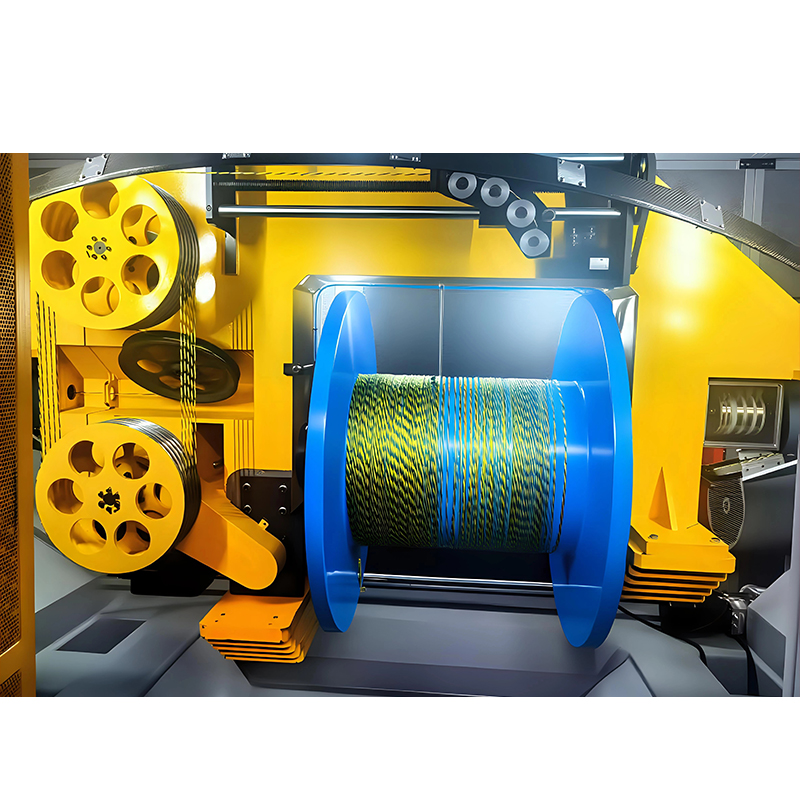
- Take-up Drum and Traverse Mechanism: Accommodates industry-standard PN-series drums on heavy-duty spindles with hydraulic drum clamping. A precision lead-screw traverse achieves level winding — maximizing drum fill and preventing conductor surface damage.
- Drive System: High-torque AC induction main motor paired with a frequency inverter for smooth speed ramping. Auxiliary drives for take-up, capstan, and traverse use servo motors with absolute encoders for repeatable positioning accuracy.
- Automatic Lubrication System: A centralized grease or oil-mist lubrication system delivers lubricant to all critical rotating components at programmed intervals, extending bearing life and reducing unplanned maintenance stops.
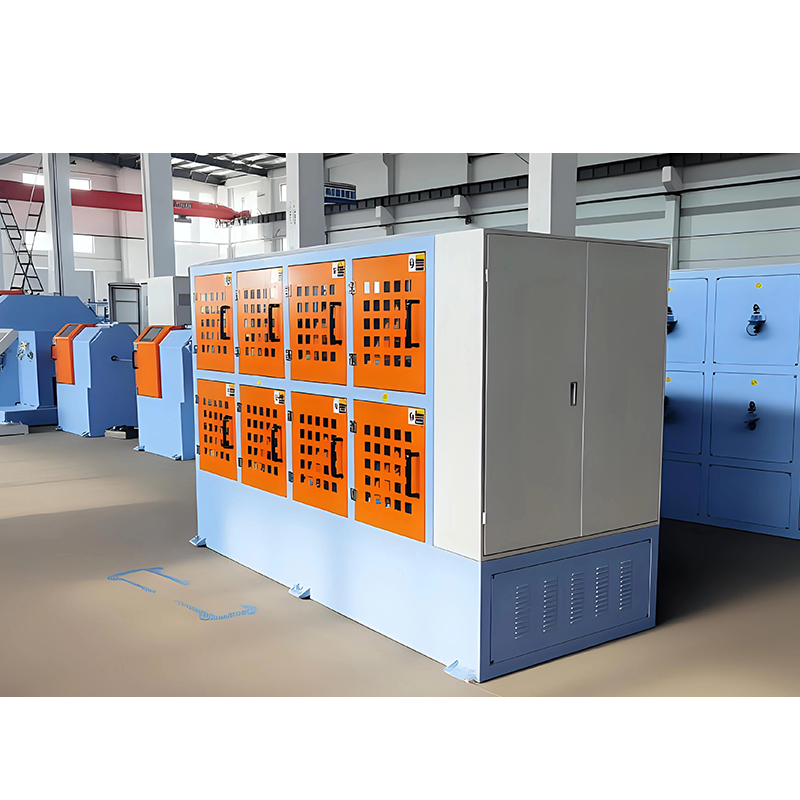
- Control Cabinet: Houses the PLC, HMI, VFDs, servo amplifiers, and I/O modules in a NEMA 12 / IP54-rated enclosure, protecting electronics from wire dust and lubricant mist inherent in cable manufacturing environments.
