


 English
 русский
 Español


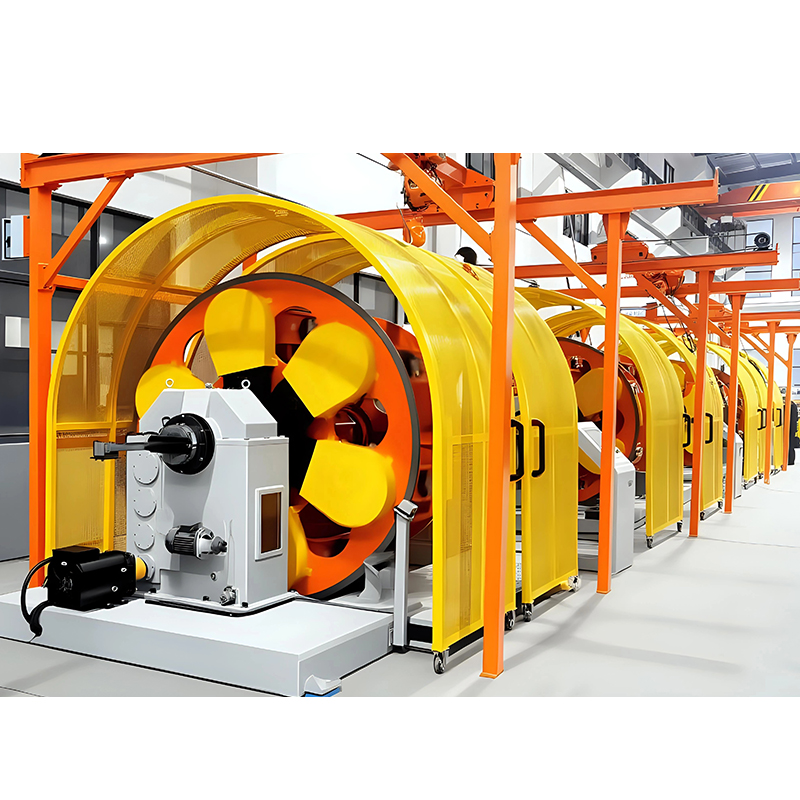
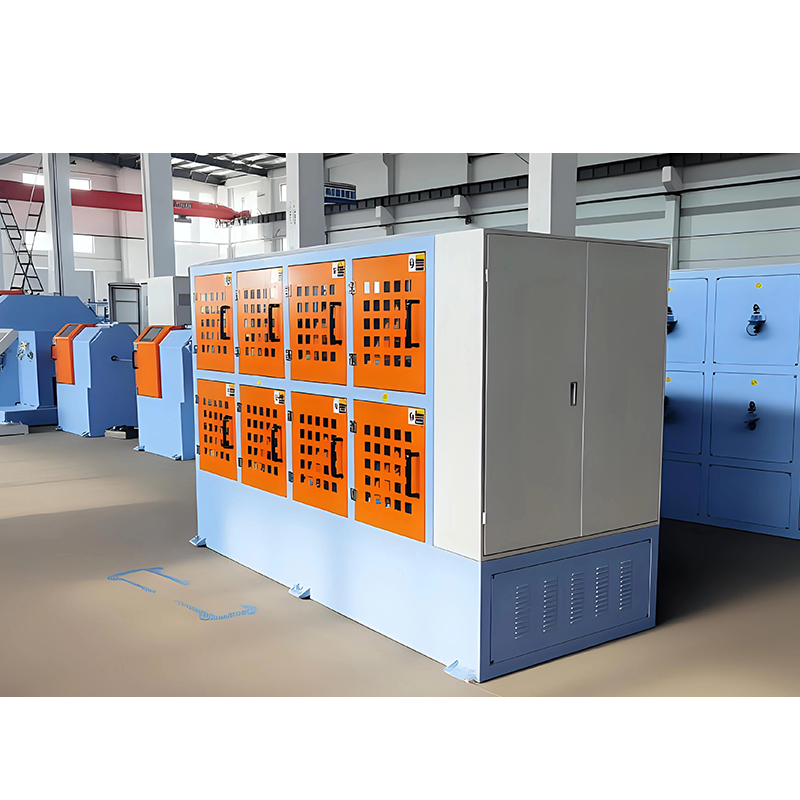
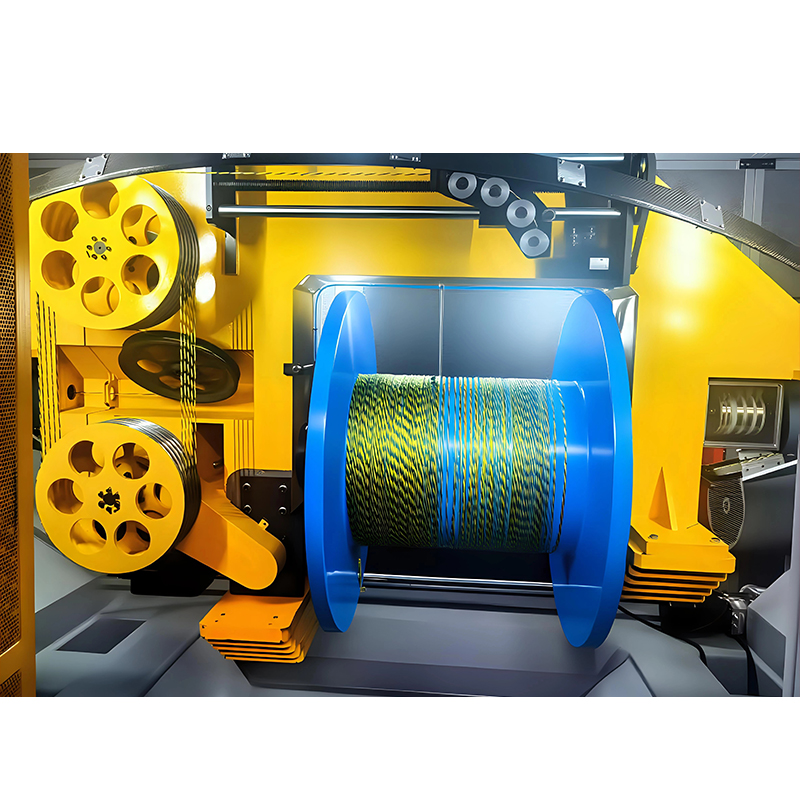


Global standards for conductor stranding include specifications for wire diameter, number...
Specification
| Number of Stranding Positions | 6 / 12 / 18 / 24 / 36 / 48 (customizable) |
| Applicable Wire Gauge | 0.05 mm – 8.0 mm diameter (copper, aluminum, steel, alloy) |
| Bobbin Inner Diameter | 160 mm / 250 mm / 400 mm / 630 mm (model dependent) |
| Max. Bobbin Weight (per spool) | 5 kg – 800 kg (varies by model) |
| Lay Length Range | 8 mm – 2,500 mm (steplessly adjustable) |
| Stranding Direction | Left-hand (S) / Right-hand (Z), switchable |
| Max. Production Speed | Up to 300 m/min (fine wire models); up to 80 m/min (heavy-duty models) |
| Main Drive Motor Power | 5.5 kW – 250 kW (VFD-controlled) |
| Take-up Spool Diameter | 400 mm – 2,500 mm |
| Max. Take-up Weight | 50 kg – 10,000 kg |
| Tension Control | Individual closed-loop dancer arm + load cell per bobbin |
| Control System | PLC (Siemens / Mitsubishi) + HMI touchscreen 10" |
| Lubrication System | Centralized automatic oil circulation |
| Electrical Supply | 380 V / 440 V / 480 V, 3-phase, 50/60 Hz (customizable) |
| Machine Frame Material | Heavy-duty welded structural steel, stress-relieved |
| Overall Dimensions (standard 24-pos.) | Approx. 18,000 × 3,200 × 2,800 mm (L×W×H) |
| Total Machine Weight (standard) | Approx. 28,000 – 85,000 kg (model dependent) |
| Noise Level | ≤ 82 dB(A) at 1 m distance |
| Protection Class | IP54 |
| Compliance | CE, ISO 9001, IEC 60228, ASTM B8, BS EN 60228 |
Application
Cage planetary stranding machines serve as a backbone process step across virtually every segment of the wire and cable manufacturing industry. Their ability to produce precise, stress-free strands from a wide variety of wire materials makes them indispensable in the following sectors:
- Power Cable Manufacturing: The machines are widely used to strand round copper or aluminum conductors for low-voltage, medium-voltage, and high-voltage power cables. ACSR (Aluminum Conductor Steel Reinforced), AAC (All Aluminum Conductor), and AAAC (All Aluminum Alloy Conductor) transmission conductors all rely on cage stranders to achieve the correct concentric lay geometry required by international standards such as IEC 60228 and ASTM B232.
- Steel Wire Rope and Strand: For structural applications — including pre-stressed concrete tendons, bridge cable stays, mining hoisting rope, and elevator traction rope — cage planetary stranders produce the 1×7, 1×19, and 1×37 wire rope constructions to the exacting dimensional tolerances required by engineering codes.
- Fiber Optic and Data Cable: Loose-tube fiber optic cables and shielded twisted-pair (STP) data cables demand precise lay length and minimal mechanical stress on the delicate fibers or signal conductors. Cage planetary stranders with low-tension dancer arm systems can handle these sensitive elements while maintaining tight tolerances on lay and outer diameter.
- Automotive and Aerospace Wiring Harnesses: Fine-gauge multi-strand conductors for automotive wiring harnesses — particularly those meeting ISO 6722, JASO D609, or SAE J1127 — are produced on cage planetary stranders that achieve excellent flexibility, low outer diameter variation, and consistent strand pitch, all critical for harness assembly automation.
- Marine and Offshore Cable: Umbilical cables, dynamic power cables, and anchor chains used in offshore oil and gas or floating wind installations require multi-layer concentric stranding with armoring wires. Heavy-duty cage planetary stranders accommodate large bobbins of galvanized steel armor wire and can be configured for dual-layer counter-stranding in a single pass.
- Medical and Instrument Cable: Ultra-fine cage stranders (working wire ranges of 0.05 – 0.3 mm) are used to produce the micro-conductors found in medical imaging cables, cochlear implant leads, catheter wiring, and precision instrument signal cables where dimensional consistency is essential.
- Renewable Energy Infrastructure: Wind turbine tower cables, solar farm DC trunk cables, and battery storage interconnects all require multi-strand conductors produced to tight dimensional tolerances. Cage planetary stranders equipped with aluminum-compatible dancer arm tension systems are the standard equipment choice for these high-growth cable segments.
Advantage
- Zero Back-Twist Technology: The planetary gear cradle ensures that each bobbin counter-rotates relative to the cage revolution, so the wire is paid off without imparting any torsion into the individual wire. This eliminates the internal stress that shortens cable fatigue life and prevents the "springing" or "birdcaging" that can occur during downstream processing.
- Consistent Lay Length Across the Full Production Run: The lay length is mechanically set through the gear ratio between the cage drive and the haul-off capstan, not through open-loop speed control. This means lay length is maintained accurately even as line speed varies during acceleration, deceleration, or bobbin changes, resulting in a uniform product from the first meter to the last.
- Wide Material Compatibility: From soft annealed copper and aluminum alloy to hard-drawn steel and stainless steel, the independently controlled tension system on each bobbin adapts to material differences in elastic modulus and surface finish, preventing wire breakage and surface damage during the stranding process.
- High Production Throughput: Cage planetary stranders achieve much higher linear production speeds than conventional bow stranders for equivalent strand diameters because the cage design allows for much higher rotational speeds without the centrifugal imbalance issues associated with heavy rotating frames. This translates to lower cost per meter and shorter lead times for your customers.
- PLC-Based Automation and Recipe Management: All key parameters — cage speed, haul-off speed, lay length, individual tension setpoints, take-up traverse pitch — are stored as digital recipes in the HMI. Changeover between product types takes minutes rather than hours, reducing setup scrap and improving OEE (Overall Equipment Effectiveness).
- Low Maintenance and High Uptime: The centralized lubrication system services all bearings and gear meshes on a timed cycle, reducing manual intervention and the risk of lubrication-related failures. Critical wear components such as die guides, capstan linings, and dancer arm pivots are designed for tool-free replacement.
- Scalable Modular Design: The cage frame is engineered in modular sections, allowing the stranding position count to be increased (e.g., from 12 to 24 positions) with a frame extension kit rather than purchasing an entirely new machine, protecting the customer's capital investment as their product range evolves.
- Reduced Scrap and Improved Cable Quality: Individual tension control per bobbin reduces wire breakage incidents significantly compared to machines with shared tension systems. Fewer breaks mean fewer splices in the finished product, lower scrap rates, and a higher proportion of on-spec product that can be shipped to end customers without rework.
Material and Structure
- Machine Frame: The main frame is fabricated from heavy-duty structural steel plate and rolled sections, continuously welded and then thermally stress-relieved at 600 °C to eliminate residual welding stresses. After stress relief, all mating surfaces are precision-machined on CNC gantry mills to ensure that the cage bearings and gear housings are accurately aligned. The frame is then shot-blasted and coated with a two-component epoxy primer followed by polyurethane topcoat for long-term corrosion resistance in industrial environments.
- Cage Assembly: The rotating cage is an open-frame fabricated steel structure that carries the bobbin cradles on a precision-bored central shaft running in double-row spherical roller main bearings. The cage is statically and dynamically balanced at full bobbin load to minimize vibration at operating speeds. All cradle pivot shafts are case-hardened and ground to H6/h5 fits for repeatable bobbin mounting.
- Gear System: The planetary gear train that controls back-twist compensation is manufactured from carburized and case-hardened 20CrMnTi alloy steel, ground to DIN class 5 accuracy. The gear housing is cast from EN-GJS-500-7 ductile iron, machined in a single clamping to maintain housing bore concentricity better than 0.01 mm. Gear ratios are selectable via change gear sets to cover the full lay length range.
- Tension Dancer Arms: Each wire position is equipped with a cast aluminum dancer arm pivoting on maintenance-free polymer bushings. The dancer displacement is sensed by a non-contact hall-effect angle sensor feeding into a closed-loop PID controller that modulates the bobbin brake torque via a pneumatic disc brake. Tension setpoints can be adjusted individually from the HMI without stopping the machine.
- Closing Die Assembly: Wires converge at the closing die, which is a tungsten carbide-lined die holder mounted in a water-cooled die box. The die holder accepts standard interchangeable closing and preforming dies in sizes from 0.5 mm to 100 mm bore. A split-die option is available for quick die changes without threading wire through the die bore.
- Haul-Off Capstan and Take-Up Unit: The haul-off capstan uses a polyurethane-lined dual sheave to grip the strand without surface damage. The take-up uses a motorized traverse arm with electronic pitch control to produce a level-wound bobbin. Both units are independently speed-controlled by VFDs synchronized to the cage drive via the PLC to maintain the programmed lay length under all operating conditions.
- Electrical and Control Cabinet: The control cabinet is rated IP54, free-standing, and pre-wired with all VFDs, safety relays, and PLC hardware. All power wiring uses flexible silicone-insulated cables suitable for continuous mechanical flexing in cable trays. The HMI panel is mounted on an articulated arm for ergonomic positioning at the operator station.
