

 English
 русский
 Español

Industry News
Home / News / Industry News / What Is Wire Extruding and Why Does It Matter in Modern Manufacturing?
Home / News / Industry News / What Is Wire Extruding and Why Does It Matter in Modern Manufacturing?
NEWS


What Is Wire Extruding and Why Does It Matter in Modern Manufacturing?
2026-05-20
Wire extruding is a continuous manufacturing process in which raw material — most commonly thermoplastic polymers or metals — is forced through a shaped die to coat, insulate, or form wire and cable products with precise dimensional and material properties. It is the backbone of electrical wire insulation, telecommunications cables, automotive wiring harnesses, and industrial power cables worldwide.
Content
- 1 How Does the Wire Extruding Process Work?
- 2 Which Materials Are Used in Wire Extruding?
- 3 Why Is Wire Extruding Critical to Electrical and Industrial Sectors?
- 4 What Are the Main Types of Wire Extruding Processes?
- 5 How to Choose the Right Wire Extruding Line for Your Application
- 6 What Quality Control Measures Are Essential in Wire Extruding?
- 7 How Wire Extruding Technology Is Evolving: Key Industry Trends
- 8 Frequently Asked Questions About Wire Extruding
- 8.1 Q1: What is the difference between wire extruding and wire drawing?
- 8.2 Q2: How thick can wire extruding insulation layers be?
- 8.3 Q3: Can wire extruding process multiple conductors simultaneously?
- 8.4 Q4: What causes surface defects in wire extruding, and how are they prevented?
- 8.5 Q5: Is wire extruding suitable for small-batch production?
- 8.6 Q6: What certifications should wire extruding output meet?
- 9 Conclusion: Why Wire Extruding Remains Indispensable
How Does the Wire Extruding Process Work?
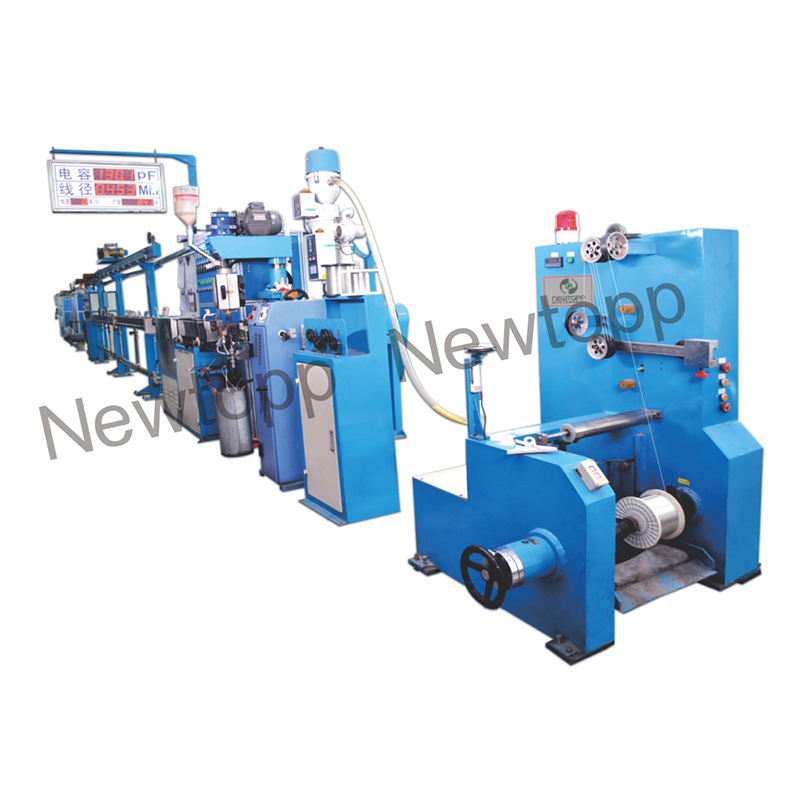
The wire extruding process works by feeding raw material into a heated barrel, melting it, and forcing the molten material through a precision die around a moving wire core. The result is a uniformly coated wire ready for downstream processing.
Here is a step-by-step breakdown of how wire extruding works in a standard production line:
- Material Feeding: Plastic pellets or granules (such as PVC, XLPE, or LLDPE) are loaded into the extruder hopper.
- Melting and Conveying: A rotating screw inside the heated barrel melts the material and pushes it forward under controlled pressure.
- Die Extrusion: The molten polymer is forced through a crosshead die that wraps it around the conductor wire passing through the center.
- Cooling: The coated wire passes through a water trough (typically 3–15 meters long) to solidify the insulation layer rapidly.
- Diameter Measurement: Laser gauges continuously monitor the outer diameter to ensure tolerances within ±0.01 mm.
- Take-Up and Spooling: The finished wire is wound onto reels at speeds ranging from 50 m/min to over 2,000 m/min depending on wire gauge and material.
Which Materials Are Used in Wire Extruding?
The most commonly used materials in wire extruding are PVC, XLPE, PE, LLDPE, TPU, and PTFE, each selected based on the wire's intended application, temperature rating, and regulatory requirements.
The table below compares the most widely used insulation materials in wire extruding:
| Material | Max Temp (°C) | Key Strengths | Typical Applications |
| PVC | 70–105 | Low cost, flame retardant, flexible | Building wire, appliance cords |
| XLPE | 90–150 | High voltage resistance, thermal stability | Power cables, underground cables |
| LLDPE | 75–90 | Excellent flexibility, chemical resistance | Telecommunications, data cables |
| TPU | 80–120 | Abrasion resistance, high elasticity | Robotics cables, drag chain cables |
| PTFE | 260 | Ultra-high temp, chemical inertness | Aerospace, medical devices |
| PE (HDPE) | 60–80 | Good dielectric, moisture resistance | Outdoor cables, coaxial cables |
Table 1: Comparison of common insulation materials used in wire extruding, including temperature ratings and typical applications.
Why Is Wire Extruding Critical to Electrical and Industrial Sectors?
Wire extruding is critical because it is the only scalable method to apply consistent, defect-free insulation at production speeds exceeding 1,000 meters per minute while maintaining strict safety and performance standards.
Without reliable wire extruding technology, modern infrastructure would be impossible to build or maintain. Consider these industry data points:
- The global wire and cable market was valued at approximately USD 225 billion in 2023 and is projected to exceed USD 320 billion by 2030, driven by electrification, EV adoption, and renewable energy expansion.
- A single electric vehicle requires between 1,500 and 3,000 meters of extruded wire across its wiring harness.
- Offshore wind turbines rely on XLPE-insulated extruded submarine cables rated at 66 kV to 525 kV to transmit power to shore.
- Data center buildouts demand millions of meters of low-smoke zero-halogen (LSZH) extruded cables annually to meet fire safety codes.
What Are the Main Types of Wire Extruding Processes?
The three main types of wire extruding processes are pressure extrusion (tube extrusion), jacketing extrusion, and tandem extrusion, each designed for different insulation requirements and wire constructions.
Pressure Extrusion (Tube-on Extrusion)
In pressure extrusion, the molten polymer is forced directly onto the conductor under high pressure, ensuring intimate contact and a dense insulation layer. This method is preferred for primary insulation applications where dielectric integrity is critical, such as high-voltage power cables and coaxial cable cores. Wall thickness uniformity of ±3% is routinely achievable.
Jacketing Extrusion (Tube Extrusion)
Jacketing extrusion applies the polymer as a loose tube over the wire or cable assembly, which is then pulled down onto the surface. This approach is ideal for outer jacket layers over pre-assembled multicore cables, providing mechanical protection, color coding, and environmental resistance without placing undue stress on internal conductors.
Tandem and Triple Extrusion
Tandem extrusion lines use two extruders in sequence to apply multiple layers (e.g., a semiconductive screen followed by XLPE insulation) in a single continuous pass. Triple extrusion — used extensively in medium- and high-voltage cable manufacturing — applies three layers simultaneously: inner semiconductive layer, XLPE insulation, and outer semiconductive layer. This process eliminates interlayer contamination and reduces production time by up to 40% compared to sequential single-layer processes.
How to Choose the Right Wire Extruding Line for Your Application
Selecting the correct wire extruding line requires evaluating five key parameters: wire gauge range, required line speed, material compatibility, cooling system capacity, and automation level.
The table below provides a practical comparison guide for different production scenarios:
| Application | Recommended Process | Typical Line Speed | Key Equipment Feature |
| Building wire (AWG 14–2) | Pressure extrusion | 200–600 m/min | High-speed take-up |
| Telecom / data cable | Tube extrusion | 500–2,000 m/min | Precision laser gauge |
| Medium-voltage power cable | Triple extrusion (CCV) | 5–30 m/min | Nitrogen dry-curing tube |
| Automotive wiring harness | Pressure extrusion | 300–800 m/min | Color change system |
| Aerospace / medical wire | PTFE extrusion (ram) | 10–80 m/min | Sintering oven integration |
Table 2: Wire extruding line selection guide by application, process type, line speed, and critical equipment features.
What Quality Control Measures Are Essential in Wire Extruding?
Effective wire extruding quality control relies on inline monitoring systems for outer diameter, eccentricity, spark testing, and capacitance measurement, combined with periodic destructive testing of insulation properties.
- Laser Diameter Gauges: Measure outer diameter at multiple axes simultaneously at rates up to 2,400 readings per second. Any deviation beyond ±0.01 mm triggers an automatic line speed correction.
- Eccentricity Monitors: Ultrasonic or X-ray wall thickness gauges detect off-center conductor placement in real time. Eccentricity above 5% is typically cause for rework in power cable applications.
- Spark Testers: High-voltage spark testers (typically 1–35 kV AC or DC) detect pinholes and voids in the insulation at 100% of production output. Industry standards such as IEC 60227 and UL 1581 specify mandatory spark test voltages by wire type.
- Capacitance Monitoring: Continuous capacitance measurement verifies insulation wall consistency and detects material contamination or air inclusion invisible to optical systems.
- Melt Pressure and Temperature Logging: Extruder screw zone temperatures and head pressure are logged at 1-second intervals to ensure process repeatability and provide traceability data for quality audits.
How Wire Extruding Technology Is Evolving: Key Industry Trends
Wire extruding technology is evolving rapidly in response to electrification megatrends, with the most significant advances occurring in high-voltage cable production, material science, energy efficiency, and digital process control.
Halogen-Free and Eco-Friendly Insulation Materials
Regulatory pressure from the EU RoHS directive and international fire safety codes is accelerating the shift from PVC to low-smoke zero-halogen (LSZH) compounds in wire extruding. LSZH materials emit minimal toxic gases in fire conditions, making them mandatory for public transport, tunnels, and marine applications. Market adoption of LSZH compounds in wire extruding grew by approximately 8.5% annually between 2020 and 2024.
Industry 4.0 and Smart Extruder Systems
Modern wire extruding lines increasingly incorporate AI-driven process control systems that use machine learning algorithms to predict die wear, optimize screw speed in real time, and reduce scrap rates. Plants deploying smart extruder controls have reported scrap reduction of 15–25% and energy savings of up to 12% per kilometer of wire produced.
High-Voltage Direct Current (HVDC) Cable Extrusion
The global expansion of offshore wind and cross-border power grids is driving demand for HVDC extruded cables rated at 320 kV to 640 kV. Producing these cables requires ultra-clean XLPE compounds with contamination particles controlled below 50 microns, and catenary continuous vulcanization (CCV) lines stretching up to 200 meters in height — among the largest wire extruding installations in the world.
Frequently Asked Questions About Wire Extruding
Q1: What is the difference between wire extruding and wire drawing?
Wire drawing reduces the diameter of a metal conductor by pulling it through a series of progressively smaller dies — it shapes the metal itself. Wire extruding, by contrast, applies a polymer coating or jacket over an already-formed conductor. The two processes are complementary: wire drawing produces the conductor, and wire extruding provides the insulation.
Q2: How thick can wire extruding insulation layers be?
Wire extruding can produce insulation wall thicknesses ranging from as thin as 0.1 mm (for ultra-fine magnet wire applications) to over 35 mm (for extra-high-voltage submarine power cables). Wall thickness is precisely controlled by the ratio of die dimensions to line speed.
Q3: Can wire extruding process multiple conductors simultaneously?
Yes. Multi-conductor extrusion lines use specially designed crosshead dies to apply insulation to two, three, or four conductors side by side simultaneously, significantly improving output for flat cable, ribbon cable, and parallel wire products. Some high-volume telecom wire extruding lines run up to 48 conductors in parallel.
Q4: What causes surface defects in wire extruding, and how are they prevented?
The most common surface defects in wire extruding are melt fracture, shark-skinning, die lines, and lumps. These are caused by factors including excessive line speed relative to melt temperature, contaminated raw material, worn die surfaces, or inadequate melt homogenization. Prevention measures include optimizing barrel temperature profiles, using processing aid additives (typically at 0.05–0.2% loading), implementing regular die cleaning protocols, and using high-precision metering screws with appropriate compression ratios for each material.
Q5: Is wire extruding suitable for small-batch production?
Wire extruding lines can be configured for both high-volume continuous production and short-run specialty applications. Micro-extruders with screw diameters as small as 16 mm are used for laboratory development and specialty wire production in quantities as low as a few hundred meters, while industrial lines with 150 mm screws run continuously for weeks at a time.
Q6: What certifications should wire extruding output meet?
Depending on the target market and application, extruded wire may need to comply with standards including UL 44, UL 83, UL 1581 (North America), IEC 60227, IEC 60502, IEC 60840 (international), BS 6004, BS 7211 (UK), and VDE 0271, VDE 0276 (Germany). Compliance is verified through a combination of inline quality systems and third-party laboratory testing.
Conclusion: Why Wire Extruding Remains Indispensable
Wire extruding is far more than a commodity manufacturing step — it is the precision engineering process that determines the safety, performance, and longevity of every insulated wire and cable product in service today. From the micro-wires inside medical implants to the massive submarine cables connecting continents, wire extruding underpins the world's electrical infrastructure.
As the global demand for electrification, EV infrastructure, renewable energy, and high-speed data transmission continues to accelerate, investment in advanced wire extruding technology — cleaner materials, smarter process controls, and higher-voltage capability — will be essential for manufacturers seeking to remain competitive in a rapidly evolving market.
Understanding the fundamentals of wire extruding processes, material selection, and quality control is therefore not merely technical knowledge — it is a strategic advantage for engineers, procurement specialists, and decision-makers across the electrical and industrial sectors.
-
Phone
+86 188 2296 5630 +86-(0)515-8510 8601Email
[email protected]
[email protected]
[email protected]
[email protected]
[email protected]
[email protected]Address
No. 168 Haitai Road, Dongtai City, Jiangsu Province, China
Copyright © 2025 Jiangsu NewTopp Precision Machinery Co., Ltd. All Rights Reserved. Wire & Cable Equipment Manufacturer
Robot Cable Production Ancillary Equipment Factory
