


 English
 русский
 Español


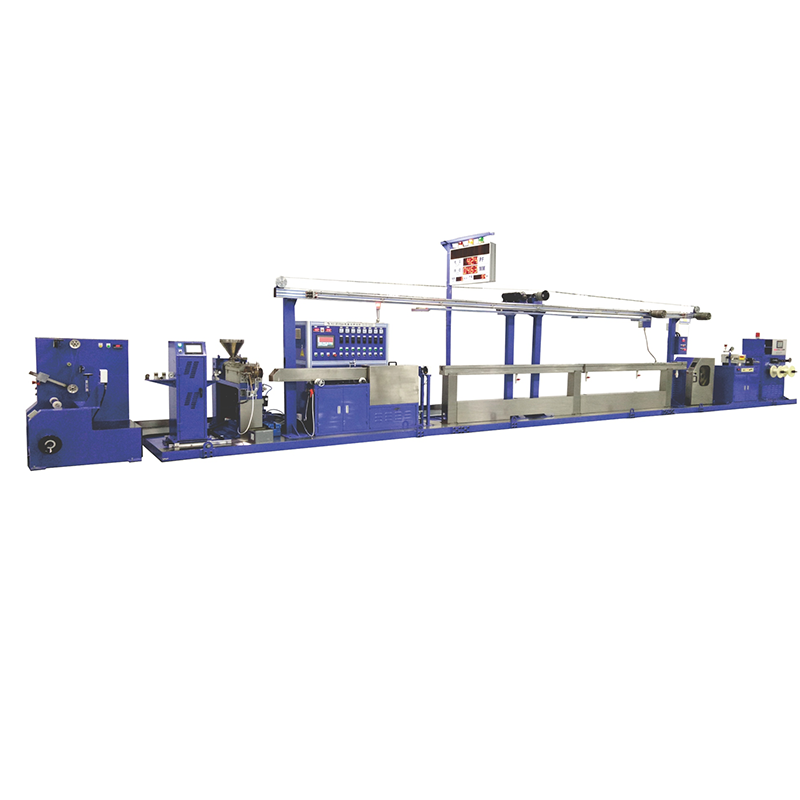
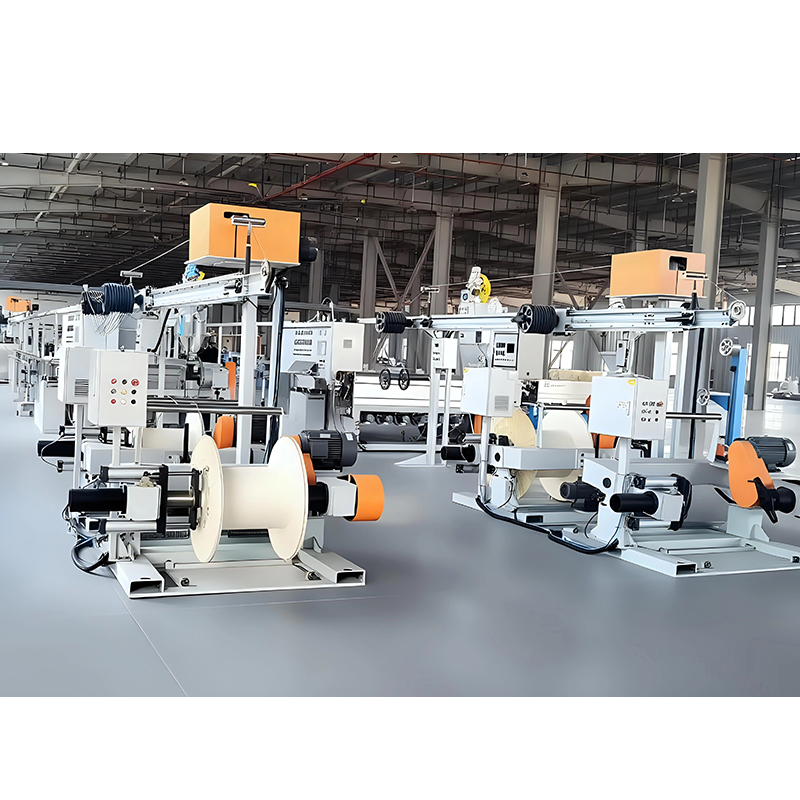


Global standards for conductor stranding include specifications for wire diameter, number...
Specification
| Parameter | Details |
| Machine Type | Ram Extruder / Screw Extruder (PTFE Paste, FEP, PFA, ETFE) |
| Applicable Wire Range | AWG 46 – AWG 4 (0.04 mm – 5.19 mm conductor diameter) |
| Screw Diameter | 20 mm / 30 mm / 45 mm / 60 mm (customizable) |
| L/D Ratio | 20:1 – 30:1 |
| Screw Material | 38CrMoAl nitrided alloy steel; optional bimetallic barrel lining |
| Barrel Temperature Zones | 4 – 8 independently controlled zones (PID precision ±1 °C) |
| Maximum Processing Temperature | Up to 400 °C (barrel); sintering oven up to 450 °C |
| Drive System | AC servo motor with vector frequency inverter |
| Motor Power | 3.7 kW – 37 kW (model dependent) |
| Extrusion Speed | 5 – 300 m/min (line speed) |
| Crosshead Die | 90° or inline; PTFE-compatible die materials (hardened tool steel + PTFE coating) |
| Insulation Wall Tolerance | ±0.01 mm (on precision models) |
| Cooling System | Water trough (ambient or chilled); optional air-cooling section |
| Sintering Oven Length | 3 m – 12 m (infrared or convection, multi-zone) |
| Spark Tester Voltage | 0 – 20 kV AC/DC (configurable) |
| Control System | Siemens / Mitsubishi PLC; 10" – 15" color touch HMI |
| Data Logging | Real-time process data recording; CSV/USB export; optional MES integration |
| Certifications | CE, ISO 9001; optional UL / MIL-SPEC compliance |
| Overall Dimensions (line) | Approx. 25 m – 60 m length (model/configuration dependent) |
| Power Supply | 3-phase 380 V / 415 V / 480 V, 50/60 Hz (configurable) |
Application
Teflon cable extruders serve as the production backbone for PTFE-insulated wire and cable across a remarkably broad range of industries. Anywhere that conventional PVC or PE insulation falls short — due to temperature extremes, chemical exposure, or demanding electrical performance — PTFE steps in, and Teflon cable extruders are how that material is put to work at scale.
- Aerospace & Aviation: Aircraft wiring harnesses must withstand temperature swings from -65 °C at cruising altitude to over 200 °C near engine bays, all while remaining lightweight and flame-retardant. PTFE-insulated hook-up wire, produced on Teflon cable extruders, is specified in virtually every commercial and military aircraft, from the cockpit avionics to the flight control surfaces.
- Military & Defense Electronics: Field communications cables, radar system interconnects, and shipboard wiring all rely on PTFE insulation for its combination of durability, wide temperature range, and excellent dielectric properties. MIL-W-22759 and similar military specifications call out PTFE as the insulation of choice, and Teflon cable extruder lines are configured to meet these exacting standards.
- Medical Devices & Equipment: From MRI machine wiring to the cables inside robotic surgical systems, medical-grade wires demand insulation that can survive repeated steam sterilization, resist body fluids and cleaning chemicals, and maintain biocompatibility. PTFE satisfies all of these requirements, and Teflon extruder lines in cleanroom-compatible configurations are used to manufacture these critical components.
- Semiconductor & Electronics Manufacturing: Inside semiconductor fabrication equipment, cables are exposed to aggressive chemicals and high temperatures. PTFE-jacketed wires and cables withstand plasma environments, strong acids, and solvents that would destroy conventional insulation within hours.
- Automotive (High-Performance & EV): High-performance vehicles and electric vehicles increasingly use PTFE-insulated wire in engine compartments, battery management systems, and high-voltage charging cables where the combination of high temperature resistance and excellent electrical insulation is essential.
- Oil & Gas / Industrial Automation: Downhole logging cables for oil exploration, thermocouple extension wires for industrial furnaces, and instrumentation cables in chemical processing plants all benefit from the exceptional chemical resistance and thermal stability of PTFE insulation produced on dedicated Teflon cable extruder lines.
- Telecommunications & RF Cables: High-frequency coaxial cables for microwave and RF applications use PTFE dielectric for its extremely low and stable dielectric constant (approximately 2.1 across a wide frequency range), minimizing signal loss. These are produced on precision Teflon extruder lines calibrated for tight wall thickness tolerances.
Advantage
Investing in a dedicated Teflon cable extruder line rather than adapting a standard thermoplastic extruder brings a series of concrete technical and commercial advantages that directly impact product quality, throughput, and long-term profitability.
- Precision Wall Thickness Control: Purpose-built Teflon extruders incorporate closed-loop diameter gauging systems that make automatic micro-adjustments to line speed and screw RPM in real time. This ensures insulation wall tolerances as tight as ±0.01 mm — a level of consistency that is simply not achievable on general-purpose machines running PTFE.
- High-Temperature Barrel & Die Integrity: PTFE processing requires barrel temperatures approaching 400 °C and sintering at up to 450 °C. Teflon cable extruders are constructed with corrosion-resistant alloy barrels, PTFE-coated flow paths, and ceramic-insulated heater bands engineered specifically for sustained operation at these temperatures without warping, seizing, or contamination.
- Consistent Sinter Quality: The integrated sintering oven with independently controlled multi-zone heating ensures that PTFE particles coalesce uniformly along the entire cable length, producing insulation with consistent mechanical strength, dielectric breakdown voltage, and surface finish — batch after batch.
- Wide Product Range from a Single Line: Many modern Teflon cable extruder configurations can run not only standard PTFE paste but also FEP and PFA compounds with die and process parameter changes. This flexibility allows manufacturers to serve diverse customer specifications from a single production line, reducing capital expenditure.
- Integrated Inline Quality Inspection: Spark testers, laser diameter gauges, and capacitance monitors built into the production line catch defects — pinholes, lumps, or eccentric insulation — in real time, minimizing waste and eliminating costly post-process inspection bottlenecks.
- Reduced Scrap and Material Waste: The combination of precise process control and inline QC dramatically reduces insulation material waste, which is significant given the high cost of PTFE compounds relative to standard thermoplastics.
- Long Service Life & Low Maintenance: Teflon cable extruders are built for durability. Hardened and nitrided screws, bimetallic barrel linings, and corrosion-resistant crossheads are designed to withstand the demanding conditions of fluoropolymer processing for years of continuous operation with minimal downtime.
- Compliance with International Standards: Machines are configured to help customers produce wire and cable compliant with UL, MIL-SPEC, AS/EN aerospace standards, and ISO quality frameworks, giving manufacturers a faster path to product certification and market access.
Material and Structure
Understanding the material composition and mechanical architecture of a Teflon cable extruder is key to selecting the right machine for your production needs and getting the most out of your investment.
Screw and Barrel Assembly
The screw is typically manufactured from 38CrMoAl alloy steel, nitrided to achieve a surface hardness of HV 900 – 1000, giving it exceptional resistance to the abrasive wear that fluoropolymer compounds can cause at high processing temperatures. For applications involving highly abrasive filled PTFE compounds, bimetallic barrel linings with centrifugally cast iron-base or nickel-base alloys are used to extend service intervals significantly.
The screw geometry for PTFE paste extrusion differs substantially from that used for conventional thermoplastics. Because PTFE paste is a lubricated powder rather than a true melt, the screw is designed with a tapered compression section optimized to consolidate and compress the paste evenly without generating excessive shear heat that could prematurely sinter the material inside the barrel.
Crosshead Die
The crosshead die is the heart of the insulation application process. In a typical 90° crosshead configuration, the conductor wire enters from the side and exits coated with PTFE through the die tip and die. The die body, tip holder, and die itself are machined from hardened tool steel and often PTFE-coated internally to prevent sticking and ensure smooth, contamination-free material flow. The die and tip are precision-ground to tolerances of ±0.005 mm to guarantee concentricity of the insulation layer around the conductor.
Sintering Oven
Because PTFE does not truly melt during extrusion — it is applied in a paste or granular dispersion state — a separate sintering oven is an integral structural component of any Teflon cable extrusion line. The oven uses infrared or convection heating across multiple independently controlled zones (typically 3 – 8 zones) to bring the PTFE coating to 360 – 400 °C, at which temperature the PTFE particles fuse into a continuous, dense, void-free insulation layer.
Drive and Control Cabinet
The main extruder drive uses an AC servo motor paired with a vector-controlled frequency inverter, providing smooth, precise speed control across the full operating range. The control cabinet houses a PLC (Siemens S7 or Mitsubishi FX/Q series are common choices) that coordinates all line sub-systems — pay-off tension, extruder speed, oven zone temperatures, capstan speed, and take-up tension — through a unified control loop, ensuring that every parameter tracks correctly as line speed changes.
Frame and Chassis
Machine frames are fabricated from heavy-gauge structural steel, stress-relieved, and precision-machined to ensure alignment accuracy across the full line length. Stainless steel is used for components in direct contact with water or the cable surface to prevent corrosion and contamination.
