


 English
 русский
 Español


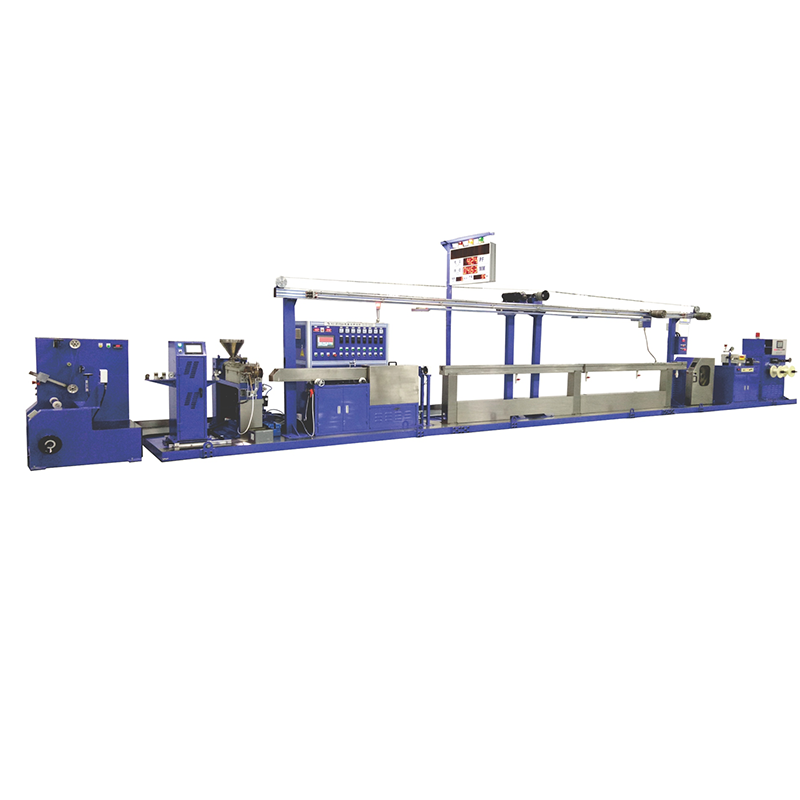
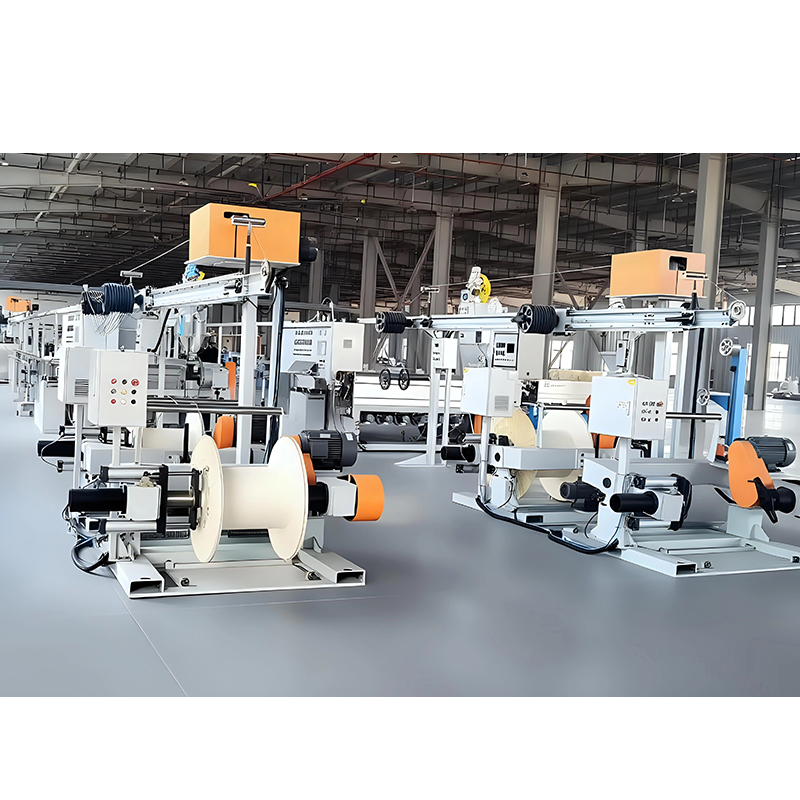


Global standards for conductor stranding include specifications for wire diameter, number...
Technical Specifications
| Screw Diameter | 20 mm / 30 mm / 45 mm / 60 mm / 90 mm / 120 mm |
| L/D Ratio | 25:1 standard; 30:1 optional (for high-output / mixing applications) |
| Screw Design | Barrier flight with distributive mixing zone; material-specific geometry |
| Barrel Material | Bimetallic alloy inner bore, HRC ≥65; nitrided outer barrel |
| Output Rate | 0.5 kg/h (20 mm) to 450 kg/h (120 mm) depending on material |
| Temperature Zones | 4 to 8 independent PID-controlled zones (barrel + adapter + crosshead) |
| Temperature Range | 40°C to 350°C (standard); up to 400°C for high-performance fluoropolymers |
| Temperature Control Accuracy | ±1°C per zone |
| Melt Pressure Sensor | At screw tip and crosshead entry (standard dual-point monitoring) |
| Drive System | AC servo main drive with encoder; closed-loop speed control ±0.1 RPM |
| Screw Speed Range | 0–180 RPM (infinitely variable) |
| Crosshead Type | Wire-pressure / pressure extrusion / tube extrusion (interchangeable) |
| Die/Tip Exchange | Quick-change system; changeover <10 minutes without dismantling |
| Inline Measurement | Laser OD gauge (optional); capacitance wall thickness gauge (optional) |
| Control System | PLC + 12" color HMI; recipe memory ≥1,000 product profiles |
| Spark Tester Interface | Standard 24V DC digital I/O for inline spark test integration |
| Power Supply | 380/400/480 V, 3-phase, 50/60 Hz |
| Standards Compliance | CE, UL (optional), IEC 61140, RoHS |
| Compatible Materials | PVC, LSZH, TPE, TPU, XLPE (pre-crosslinked), Silicone, PTFE (ram type), PE, PP |
Applications
Flexible Cable Extruders are the production solution for cable types that must survive repetitive mechanical stress without insulation cracking, delamination, or conductor exposure. The following application categories represent the primary end-use markets our extrusion lines serve.
- Drag Chain (Energy Chain) Cables — Cables running in continuous-flex cable carriers require insulation and jacketing compounds that can sustain millions of bending cycles without developing fatigue cracks. TPE and TPU jacketing extruded on our lines meets the demanding requirements of IGUS and similar energy chain suppliers.
- Robotic Arm Cables — Six-axis industrial robots impose torsional and bending stresses simultaneously on their wiring harnesses. Our extruders apply highly elastic TPU or silicone jackets with precise wall thickness concentricity, giving the cable predictable flex life in all planes of motion.
- Servo and VFD Motor Cables — High-flex servo cables for CNC machines and motion control systems require LSZH or PVC insulation applied at consistent wall thicknesses to maintain rated voltage withstand and capacitance-per-unit-length values throughout the cable's working life.
- Mining and Quarrying Cables — Trailing cables for mining equipment face abrasion, chemical exposure, and flexing over large radii. Heavy-walled CPE or LSZH-CPE jackets are extruded at higher melt pressures to achieve the density and adhesion needed for mining-grade performance.
- Medical Device Cables — Imaging system cables, surgical tool cords, and patient monitoring leads require thin-walled biocompatible TPU or silicone insulation applied with extreme concentricity consistency. Our small-diameter extruders (20 mm, 30 mm) provide the output stability needed for medical-grade production runs.
- Portable Tool and Appliance Cords — IEC 60227 and IEC 60245 flexible cords for power tools, household appliances, and extension leads are high-volume production items where our extruders deliver consistent dimensional quality at the output rates required for economical production.
- Weld Cable — Heavy-gauge welding cables require thick natural rubber or EPDM jackets applied by pressure extrusion crossheads at controlled temperatures to achieve the toughness and flexibility that welding environments demand.
- Automotive Wiring Harness — Thin-wall and ultra-thin-wall PVC or XLPE insulation for automotive wire is applied at high line speeds on our extruders, with inline diameter gauging ensuring compliance with ISO 6722 and LV 216 thin-wall specifications.
Key Advantages
- Melt Stream Stability — Barrier flight screw design and independently PID-controlled temperature zones deliver a homogenous melt at stable pressure, eliminating the wall thickness variation that causes premature insulation failure in flex applications.
- Material Versatility — Material-specific screw geometries, interchangeable crosshead tooling, and a wide temperature operating range allow processing of the full spectrum of flexible cable compounds from standard PVC to high-performance fluoropolymers on the same machine platform.
- Quick-Change Tooling — The quick-change die and tip system reduces crosshead changeover to under ten minutes, enabling multiple cable sizes or materials to be produced on a single shift without excessive downtime between production orders.
- Inline Quality Integration — Native interfaces for laser OD gauges, capacitance gauges, and spark testers allow real-time quality monitoring and automatic line speed adjustment to maintain OD within specification, reducing trim scrap and reel rejection rates.
- Long Barrel Life — Bimetallic barrel construction with HRC ≥65 inner bore hardness extends service life significantly compared to standard nitrided barrels, reducing the cost impact of barrel replacement in abrasive compound applications.
- Energy-Efficient Operation — Ceramic fiber barrel insulation and an efficient servo drive system reduce energy consumption per kilogram of compound processed compared to conventional cast-aluminum heater band systems.
- Comprehensive Recipe Management — Storage of up to 1,000 product profiles with full parameter sets for each compound and cable size enables consistent quality reproduction across shifts and operators, reducing reliance on individual operator experience.
- Compact Footprint — Despite their output capability, our extruders are designed with a compact barrel arrangement and integrated control cabinet to minimize floor space requirements in production environments where space is at a premium.
Material and Structure
The physical construction of a cable extruder must balance several demanding requirements: thermal stability across a wide operating temperature range, mechanical rigidity under sustained thrust and torque loads, chemical resistance to processing compounds and purging agents, and long-term dimensional stability of the bore and die head seating surfaces. Our extruders are designed to meet these requirements using proven material choices and precision manufacturing practices.
- Barrel and Screw — The barrel inner bore is formed from a centrifugally cast bimetallic alloy liner with hardness ≥HRC 65, bonded metallurgically to an outer carbon steel barrel jacket. Screws are manufactured from vacuum-arc-remelted tool steel, precision CNC-ground to ±0.02 mm on all functional diameters, and surface-hardened to HRC 58–62. The screw-barrel clearance is set at 0.08–0.12 mm (depending on screw diameter) to optimize melt mixing while controlling back-leakage.
- Gearbox and Thrust Bearing — The screw drive gearbox uses helical gear sets precision-ground for low noise and long service life, housed in a rigid cast iron casing with forced oil lubrication. An oversized angular contact thrust bearing assembly absorbs axial screw loads that would otherwise accelerate barrel wear during high-output operation.
- Heating and Cooling System — Barrel zones are heated by cast-on ceramic resistance heaters with integral type-J thermocouples. Cooling is by forced air (standard) or water-cooled plates on the feed zone and barrel Zone 1 to prevent compound pre-melting at the hopper throat. Crosshead heating uses cartridge heaters in a stainless steel body, with individual zone thermocouples.
- Crosshead Body — Machined from tool steel, fully hardened and polished in the melt-contact flow channels. The crosshead-to-barrel adapter joint uses a precision-machined bolted flange with a controlled seating angle that prevents melt leakage even at elevated process pressures up to 350 bar.
- Die and Tip Tooling — Standard dies and tips are produced from hardened tool steel with mirror-polished bores. For abrasive or corrosive compound families, tungsten carbide or ceramic dies are available as alternatives. All tooling is interchangeable within each crosshead size category.
- Machine Base Frame — Heavy-gauge welded structural steel frame, stress-relieved, painted with industrial epoxy primer and polyurethane topcoat for chemical resistance. Adjustable leveling feet with anti-vibration pads are standard.
