

 English
 русский
 Español


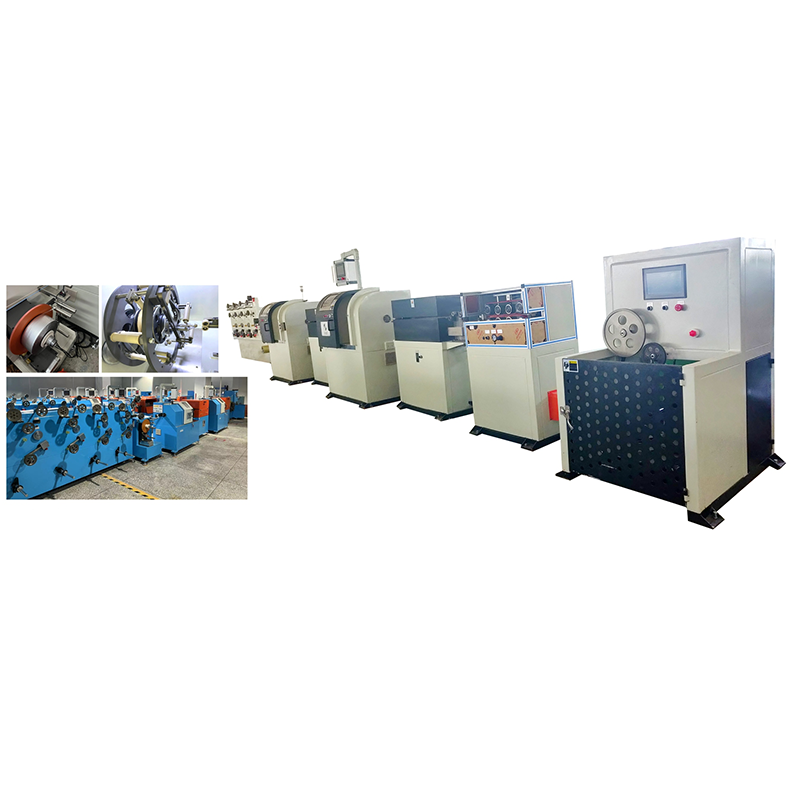
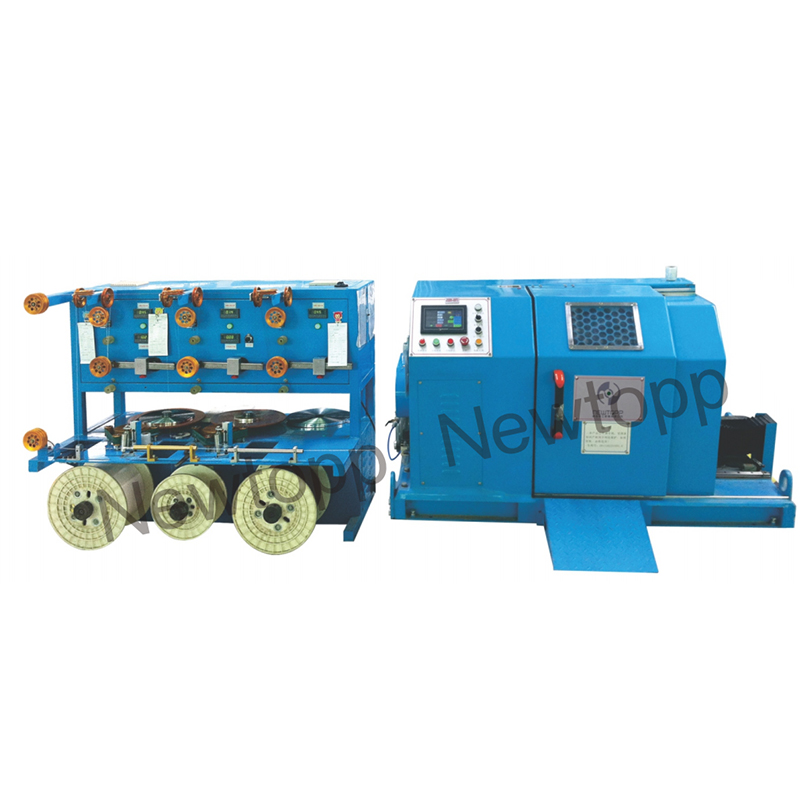
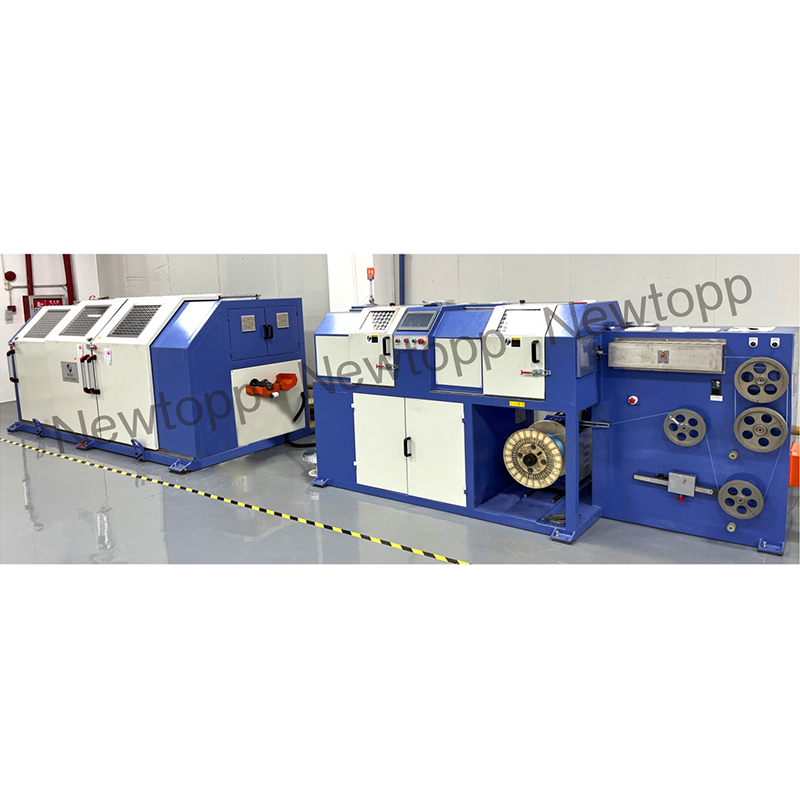
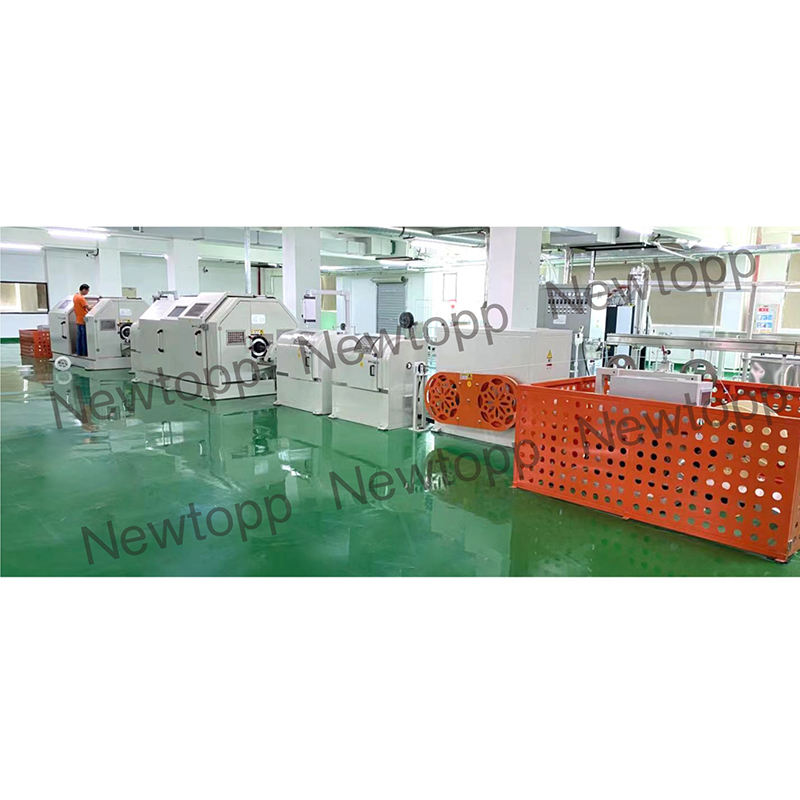
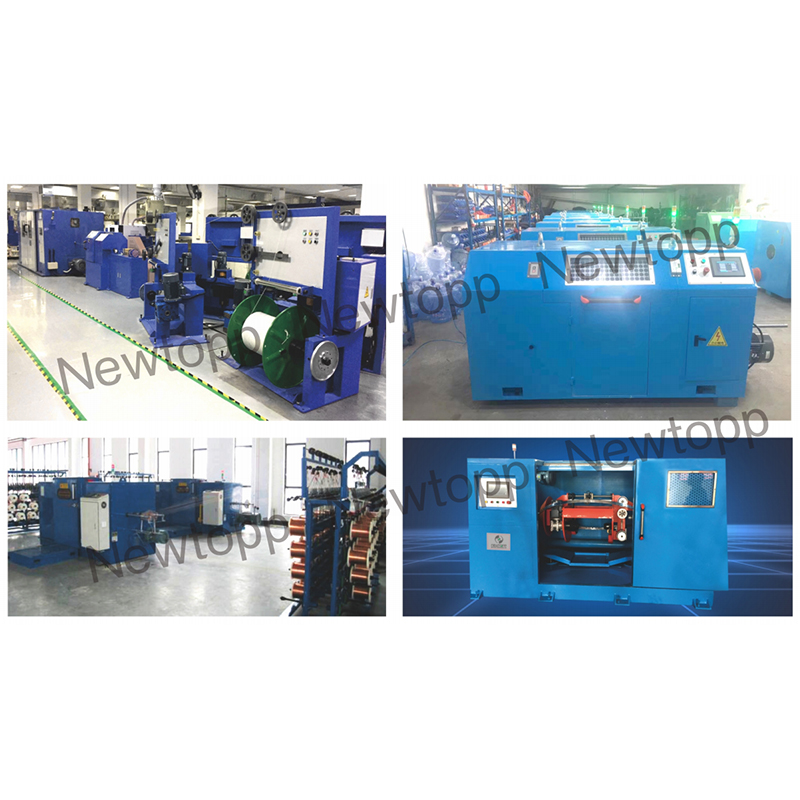
A wire cable extrusion machine works by melting thermoplastic or thermoset insulation material and continuously coating it over a conductor — wire or cable — at precise thickness and speed. It is the core piece of equipment in any cable manufacturing facility, determining product quality, production efficiency, and compliance with international electrical standards. This guide explains how these machines operate, what types exist, how key specifications compare, and what to look for when selecting one for your production line.
Content
- 1 What Is a Wire Cable Extrusion Machine?
- 2 How Does a Wire Cable Extrusion Machine Work? Step by Step
- 3 Types of Wire Cable Extrusion Machines
- 4 Wire Cable Extrusion Machine Types Compared
- 5 Key Components of a Wire Cable Extrusion Machine
- 6 Which Insulation Materials Can a Wire Cable Extrusion Machine Process?
- 7 How to Choose the Right Wire Cable Extrusion Machine
- 8 Common Problems in Wire Cable Extrusion and How to Solve Them
- 9 Frequently Asked Questions: Wire Cable Extrusion Machine
- 9.1 Q: What is the difference between a wire extrusion machine and a cable extrusion machine?
- 9.2 Q: How much does a wire cable extrusion machine cost?
- 9.3 Q: What is the typical output speed of a wire cable extrusion machine?
- 9.4 Q: Can one wire cable extrusion machine process both PVC and LSZH?
- 9.5 Q: How long does a wire cable extrusion machine last?
- 9.6 Q: What safety features should a wire cable extrusion machine include?
- 10 Summary: Key Takeaways for Selecting a Wire Cable Extrusion Machine
What Is a Wire Cable Extrusion Machine?
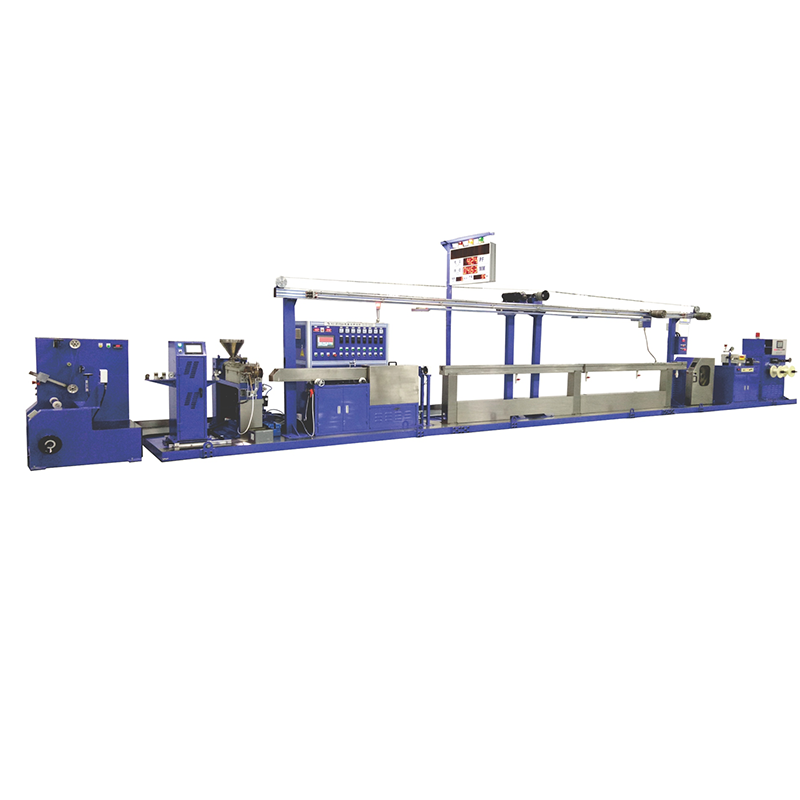
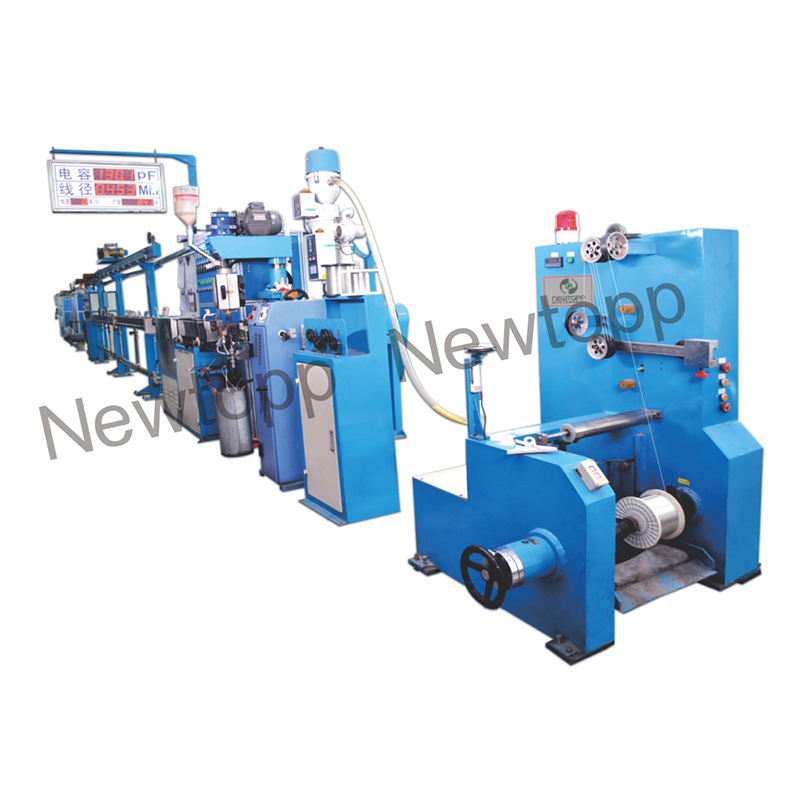
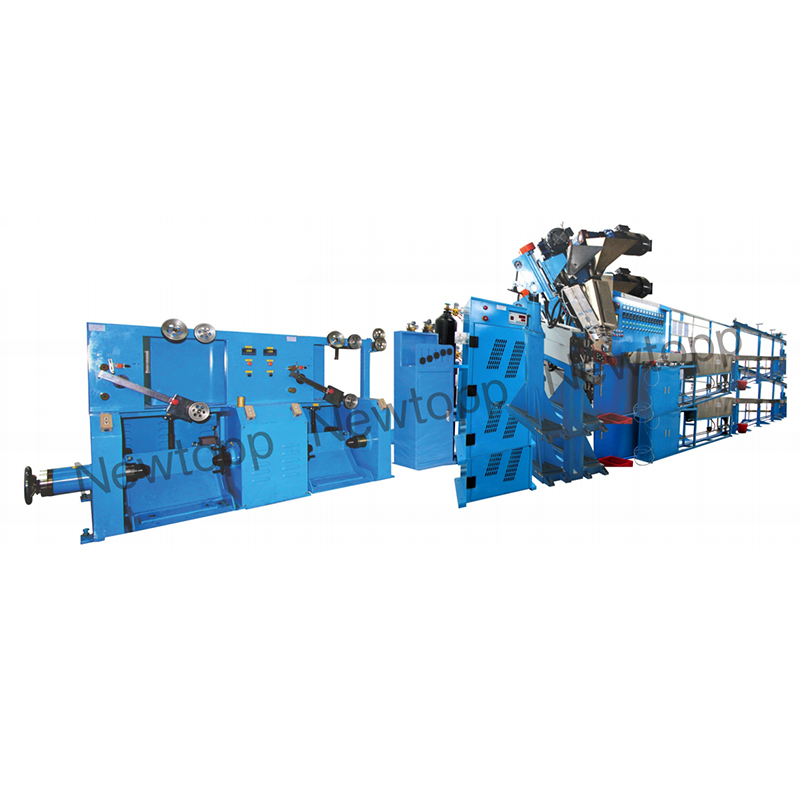
A wire cable extrusion machine is an industrial system that applies a continuous layer of insulating or jacketing polymer over a bare conductor through a process called extrusion. The conductor — typically copper or aluminum — is fed through a crosshead die while molten plastic is forced around it under pressure, forming a uniform coating as the wire exits and is cooled in a water trough.
This process is used to produce virtually every type of insulated wire and cable used in industries including power transmission, telecommunications, automotive, aerospace, and consumer electronics. A single wire extrusion line can produce anywhere from a few hundred meters to over 1,500 meters of finished cable per hour, depending on the conductor size and insulation thickness.
How Does a Wire Cable Extrusion Machine Work? Step by Step
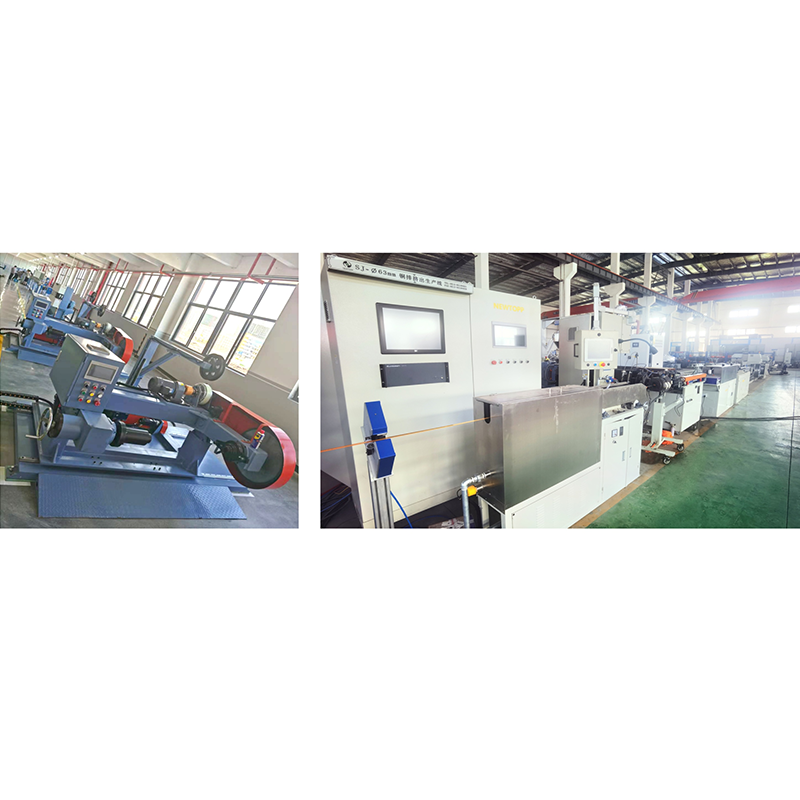
The wire cable extrusion process follows a linear sequence of stages, each handled by a dedicated section of the extrusion line. Understanding each stage is essential for optimizing output and diagnosing quality issues.
Stage 1: Pay-Off (Wire Feed)
The bare conductor is unwound from a pay-off spool and fed into the line at a controlled tension. Consistent tension is critical — fluctuations of more than 5–10% can cause eccentricity in the insulation coating. Most modern pay-off units include a dancer arm or closed-loop tension control system to maintain stability.
Stage 2: Pre-Heating
The conductor passes through a pre-heater that raises its surface temperature to 60–150°C before it enters the crosshead. Pre-heating serves two purposes: it removes moisture from the conductor surface and improves adhesion between the conductor and the insulation material. Skipping this step can cause voids or delamination in the finished product.
Stage 3: Extruder and Crosshead
The extruder barrel melts the insulation compound and forces the molten polymer through the crosshead die, where it is applied over the conductor. The extruder screw rotates at speeds typically between 20–120 RPM, generating both heat (through friction) and pressure (usually 10–30 MPa at the die). The L/D ratio of the screw — the ratio of its length to its diameter — is a key indicator of mixing and melting quality; ratios of 20:1 to 30:1 are standard for wire insulation applications.
Stage 4: Cooling Trough
Immediately after the crosshead, the coated wire enters a water cooling trough, typically 5–15 meters long, to solidify the insulation rapidly. Water temperature is usually maintained between 15–30°C. Insufficient cooling leads to surface defects, while excessive cooling rates can cause residual stresses or shrinkage voids in thick insulation walls.
Stage 5: Spark Tester (Online Quality Check)
Every modern wire cable extrusion line includes an inline spark tester that applies a high-voltage electrical field (typically 0.5–15 kV) to the insulated wire to detect pinholes or thin spots in real time. When a defect is detected, the tester triggers an alarm and marks the defect location, allowing operators to quarantine or reprocess that section. This step is mandatory for cables used in safety-critical applications.
Stage 6: Diameter Gauge and Eccentricity Measurement
A laser or optical diameter gauge continuously measures the outer diameter of the insulated wire and feeds data back to the extruder speed control system. Eccentricity — the off-center positioning of the conductor within the insulation — is also monitored. Eccentricity values below 5% are required for most international standards including IEC 60227 and UL 83.
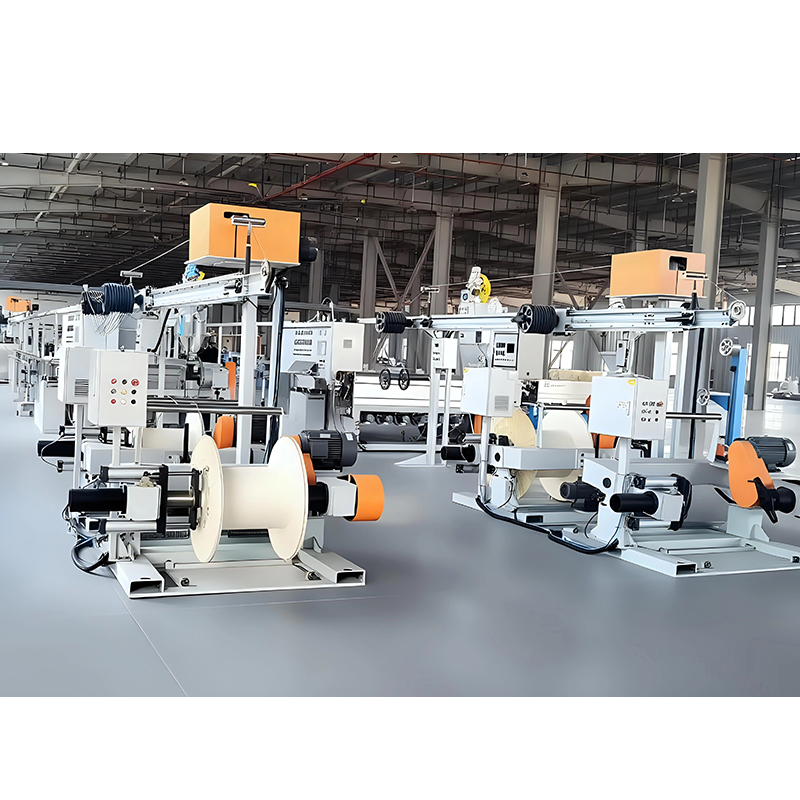
Stage 7: Haul-Off and Take-Up
The haul-off unit pulls the wire through the line at a precisely controlled speed that determines insulation wall thickness, while the take-up unit winds the finished cable onto spools. The ratio between extrusion speed and haul-off speed is one of the primary controls for achieving the specified insulation thickness. Take-up spool sizes range from a few kilograms for small gauge wire to over 2,000 kg for power cables.
Types of Wire Cable Extrusion Machines
Wire cable extrusion machines are classified primarily by extruder configuration and the type of cable they are designed to produce. Selecting the wrong type for your application results in poor product quality and wasted material.
Single Screw Extruder Lines
Single screw extruders are the most widely used configuration in wire and cable production, accounting for over 70% of installed lines globally. They offer a good balance of simplicity, output rate, and material compatibility. Standard screw diameters range from 30 mm to 150 mm, with output rates of 20–500 kg/h depending on the material.
Tandem Extrusion Lines
A tandem line uses two extruders in sequence, allowing two layers of different materials to be applied to the conductor in a single pass. This is commonly used for cables requiring both a primary insulation layer and an outer jacket — for example, PVC-insulated, PVC-jacketed power cables (NYY or VVF type). Tandem lines reduce handling steps and improve concentricity compared to running the cable through two separate lines.
Co-Extrusion Lines
Co-extrusion uses a single crosshead with multiple material inputs to apply two or more layers simultaneously, bonded at the interface. This technique is used for specialized cables such as XLPE-insulated medium voltage cables, foamed-skin insulation for coaxial cables, and dual-layer fire-resistant cables. Co-extrusion requires tighter process control but produces superior layer adhesion.
High-Speed Fine Wire Extrusion Lines
Designed for conductors below 0.5 mm diameter, fine wire lines operate at haul-off speeds of 500–2,000 m/min and require precision crossheads with bore diameters as small as 0.3 mm. These are used for magnet wire, communication wire, and automotive harness wire. Temperature uniformity across the die must be held to within plus or minus 1°C to prevent diameter variation at these speeds.
Wire Cable Extrusion Machine Types Compared
| Machine Type | Typical Line Speed | Layers Applied | Best Application | Capital Cost (Relative) |
| Single Screw | 20–300 m/min | 1 | General insulation, jacketing | Low–Medium |
| Tandem | 30–200 m/min | 2 (sequential) | Power cables (insulation + jacket) | Medium |
| Co-Extrusion | 20–150 m/min | 2–3 (simultaneous) | XLPE, coaxial, fire-resistant cables | High |
| Fine Wire High-Speed | 500–2,000 m/min | 1 | Magnet wire, telecom wire, harness | High |
Table 1: Comparison of wire cable extrusion machine configurations by line speed, layer capability, application, and relative capital cost.
Key Components of a Wire Cable Extrusion Machine
The overall performance of a cable extrusion line is determined by the quality and compatibility of its individual components. Below are the critical components that most directly affect output quality.
The Extruder Screw and Barrel
The screw is the heart of the machine — its geometry determines how thoroughly the polymer is melted, mixed, and pressurized. Screws are designed for specific material families: a screw optimized for PVC will underperform with XLPE or LSZH (low-smoke zero-halogen) compounds. The barrel is typically nitrided steel or bimetallic, with the bimetallic variant offering 3–5 times longer service life when processing abrasive or corrosive materials such as LSZH or fluoropolymers.
The Crosshead Die
The crosshead die is the tooling through which both the conductor and the molten insulation pass simultaneously, forming the coated product. Die design (pressure vs. tube tooling) affects whether the insulation is applied under pressure (better adhesion) or in a tube around the wire (better for specific insulation types like PTFE). Crosshead alignment must be accurate to within 0.05 mm to achieve acceptable eccentricity values.
Temperature Control Zones
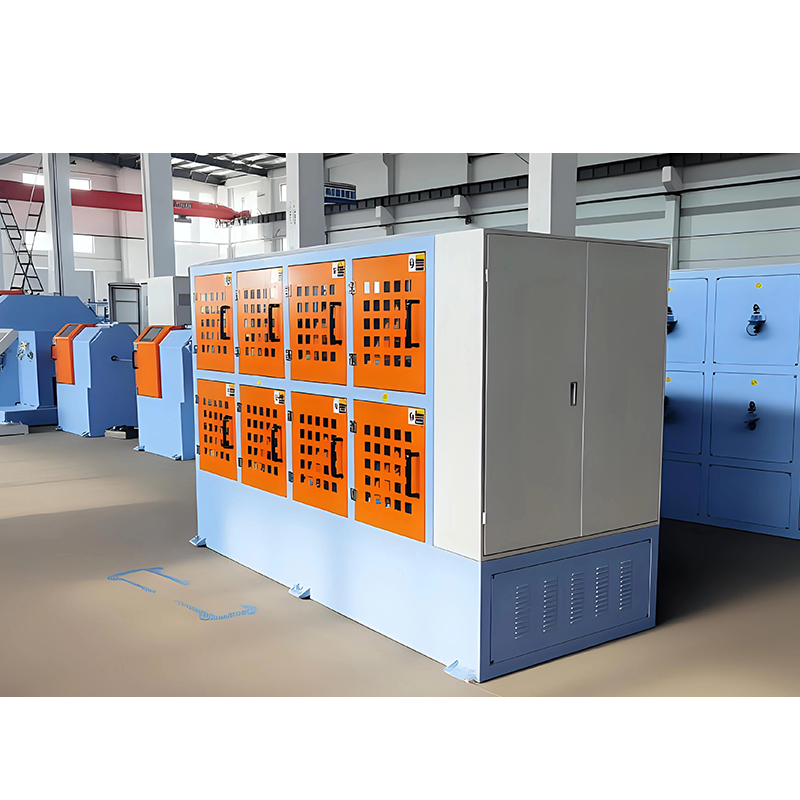
A modern wire cable extrusion machine has between 4 and 10 individually controlled heating zones from the feed throat to the die tip. Precise zone-by-zone temperature profiling is essential for processing heat-sensitive materials. PVC typically processes at 160–200°C; XLPE at 200–240°C; PTFE at 330–380°C. PID (Proportional-Integral-Derivative) controllers with accuracy of plus or minus 1°C are the industry standard.
Drive System
The screw drive system — typically a variable-frequency AC drive (VFD) or DC drive coupled to a gearbox — must deliver consistent torque across the full operating speed range. Modern servo-driven haul-off units can hold line speed accuracy to within plus or minus 0.1%, which directly translates to insulation wall thickness consistency within plus or minus 0.01 mm on small gauge wire.
Which Insulation Materials Can a Wire Cable Extrusion Machine Process?
A well-configured wire cable extrusion machine can process the full range of thermoplastic and crosslinkable insulation compounds used in the cable industry. Material selection drives both machine configuration and operating parameters.
| Material | Processing Temp (°C) | Key Properties | Typical Application | Special Requirements |
| PVC | 160–200 | Flexible, flame-retardant, low cost | Building wire, power cords, control cables | Corrosion-resistant barrel |
| XLPE | 200–240 | High temp rating (90°C+), moisture resistant | Medium/high voltage cables, solar cables | CV tube or steam crosslinking unit |
| LSZH | 180–220 | Low smoke, halogen-free, fire-safe | Transport, tunnels, public buildings | Bimetallic screw, high torque drive |
| PE (HDPE/LDPE) | 180–240 | Excellent dielectric, moisture barrier | Telecom cables, underground power | Long cooling trough |
| PTFE / FEP | 330–380 | Extremely high temp, chemically inert | Aerospace, military, medical cables | Specialized high-temp extruder |
| TPE / TPU | 170–210 | Flexible, abrasion-resistant, recyclable | Automotive harness, portable tools, EV cables | Low shear screw design |
Table 2: Common insulation materials processed by wire cable extrusion machines with processing temperatures, properties, and special requirements.
How to Choose the Right Wire Cable Extrusion Machine
Selecting the right wire cable extrusion machine starts with clearly defining your conductor size range, target materials, required output speed, and quality standards. The following factors should guide the decision-making process.
1. Define Your Conductor Size Range
Extruder screw diameter and crosshead bore must be matched to the range of conductor sizes you plan to run. As a general guideline: a 45 mm extruder is suitable for conductors from 0.5 to 6 mm2; a 60–90 mm extruder for 1.5 to 50 mm2; and 120+ mm extruders for large power cables above 50 mm2. Running a small conductor on an oversized extruder increases material residence time and the risk of thermal degradation.
2. Match the Machine to Your Primary Insulation Material
If your production will focus on a single material — for example, PVC building wire — a standard single screw line with a corrosion-resistant barrel is sufficient. If you need to process multiple materials including LSZH and XLPE, specify a bimetallic barrel, a high-torque drive (to handle the higher viscosity of LSZH), and a modular crosshead that accommodates tooling changes without full disassembly.
3. Evaluate the Control System
A modern PLC-based control system with a touchscreen HMI (Human-Machine Interface) dramatically reduces setup time and operator error. Look for systems that store and recall production recipes (conductor type, material, speed profile, temperature profile) for each product, so line changeovers that once took 60–90 minutes can be reduced to 15–20 minutes. Closed-loop diameter control, where the laser gauge feeds back to the haul-off drive, is now standard on all quality machines and reduces material waste by 8–15% compared to manual control.
4. Assess the Cooling System Capacity
Cooling trough length must be matched to line speed and insulation wall thickness — under-cooled cable causes downstream quality failures. A simple formula used in the industry is that for every 1 mm of insulation wall thickness, approximately 1 meter of cooling trough length is required per 10 m/min of line speed. For high-speed fine wire lines, pressurized water cooling or air quench systems may be required.
5. Verify Compliance and Safety Standards
Any wire cable extrusion machine supplied for industrial use should comply with applicable machinery safety directives and carry CE marking (for markets requiring EU compliance) or equivalent. The electrical cabinet should be built to IEC 60204-1 standards. For the cable products themselves, the machine's measurement and control systems should be capable of meeting the relevant product standards — IEC 60227, IEC 60228, UL 83, or GB/T standards depending on your target market.
Common Problems in Wire Cable Extrusion and How to Solve Them
Most quality defects in cable extrusion can be traced to one of five root causes: incorrect temperature, speed mismatch, tooling wear, material contamination, or mechanical instability.
- High eccentricity: Usually caused by misaligned crosshead tooling, uneven conductor tension, or worn centering bushings. Check tooling alignment with a centering gauge and recalibrate tension control.
- Diameter variation: Most often caused by unstable haul-off speed or fluctuating melt pressure. Enable closed-loop diameter control and check for material feed inconsistencies at the hopper.
- Surface roughness or shark-skin: Indicates melt fracture from excessive shear rate or insufficient barrel temperature in the metering zone. Reduce screw speed or raise zone temperatures by 5–10°C.
- Voids or bubbles in insulation: Typically caused by moisture in the compound, inadequate pre-drying, or air entrapment at the screw feed zone. Ensure compound is dried to below 0.05% moisture content before processing.
- Spark tester failures: Indicate pinholes from contamination, underfilled insulation, or die damage. Inspect tooling under magnification and filter incoming compound through a screen pack of 80–150 mesh.
Frequently Asked Questions: Wire Cable Extrusion Machine
Q: What is the difference between a wire extrusion machine and a cable extrusion machine?
A wire extrusion machine typically handles single conductors below 10 mm2, while a cable extrusion machine is configured for larger, multi-core, or armored products. In practice, the same machine platform is often used for both, with tooling and downstream equipment changed to suit the product. The term "wire cable extrusion machine" is used to describe equipment capable of handling both categories.
Q: How much does a wire cable extrusion machine cost?
A basic single-screw wire insulation line starts at approximately USD 80,000–150,000 for a complete line including extruder, crosshead, cooling trough, spark tester, and haul-off. Mid-range tandem or co-extrusion lines for power cable production typically cost USD 300,000–800,000. High-speed fine wire lines or fully automated lines with integrated measurement and control systems can exceed USD 1,500,000. Cost varies significantly by extruder size, automation level, material compatibility, and country of manufacture.
Q: What is the typical output speed of a wire cable extrusion machine?
Output speed depends entirely on conductor size and insulation thickness. For small gauge wire (0.5–1.5 mm2) with thin PVC insulation, speeds of 200–500 m/min are achievable. For 10–50 mm2 power cables with thick insulation walls, speeds of 30–80 m/min are typical. XLPE medium voltage cables run much slower, at 5–20 m/min, due to the crosslinking process requirements.
Q: Can one wire cable extrusion machine process both PVC and LSZH?
Yes, but the machine must be specified for LSZH processing from the outset, as LSZH compounds are more abrasive and viscous than PVC. Key requirements include a bimetallic screw and barrel, a higher-torque drive system, and thorough purging procedures between material changes to prevent cross-contamination. Downgrading a PVC-only machine to handle LSZH results in accelerated wear and inconsistent output.
Q: How long does a wire cable extrusion machine last?
A well-maintained wire cable extrusion machine has a productive service life of 15–25 years, with major components such as the extruder barrel and screw typically requiring replacement every 5–10 years depending on materials processed. Bimetallic barrels processing abrasive LSZH compounds may last 8–12 years compared to 3–5 years for standard nitrided steel. Regular preventive maintenance — including screw/barrel clearance checks every 6 months — is the single most effective way to extend machine life.
Q: What safety features should a wire cable extrusion machine include?
Essential safety features include emergency stop buttons at all operator stations, thermal runaway protection on all heating zones, screw torque overload protection, guarded nip points on haul-off and take-up units, and spark tester interlock systems. The high-voltage spark tester (up to 15 kV) must be fully enclosed with interlocked access panels. For fluoropolymer processing lines, fume extraction systems are mandatory due to the toxicity of decomposition gases above 380°C.
Summary: Key Takeaways for Selecting a Wire Cable Extrusion Machine
The right wire cable extrusion machine for your operation is one that matches your conductor range, primary insulation material, required throughput, and quality standard requirements — not simply the largest or fastest machine available. Start by specifying these four parameters precisely, then evaluate extruder screw diameter, barrel material, control system capability, cooling capacity, and in-line quality monitoring before making a purchasing decision.
For new entrants to cable manufacturing, a modular single-screw line with a 45–60 mm extruder, PVC/LSZH-compatible barrel, laser diameter gauge, and PLC recipe management covers the majority of building wire and control cable products at a practical capital investment. As production scales and product diversity increases, upgrading to tandem or co-extrusion capability delivers the flexibility to capture higher-value cable segments without duplicating the entire line infrastructure.